September 8, 2023
What is Annual Recurring Revenue (ARR)?


TABLE OF CONTENTS
RELATED POSTS


Whether you offer short-term contracts or multi-year contracts, annual recurring revenue (ARR) is a key metric for businesses studying the financial health of their subscription model.
The subscription industry is changing fast. Acquisition rates have fallen, competition is fiercer than ever, and changing regulations have dramatically impacted how consumers interact with subscriptions. No longer is it a “set and forget” type of purchase for many customers.
For subscription businesses, long-term health hinges on customer retention. ARR serves as an ideal metric for gauging the effectiveness of your retention strategies. Let’s dive into the basics of ARR.
Recommended reading: Subscription business model metrics guide
What is annual recurring revenue (ARR) and why is it important for SaaS businesses??
The ARR metric shows the predictable annual revenue for a business in a year. Businesses that operate on a subscription-based model are most likely to benefit from ARR calculations. If you are familiar with it, ARR is the annualized version of the monthly recurring revenue (MRR) measurement.
Hello and welcome. In this video, you'll learn everything you need to know about monthly and annual recurring revenue in subscription businesses to help you evaluate your business' growth and revenue momentum.

Let's get started.

What is monthly recurring revenue? Monthly recurring revenue or MRR for short is the recurring revenue your company expects you receive from subscriptions in a month, allowing you to average your pricing plans and billing period into a single consistent number.

ARR, on the other hand, is the annualized version. It allows you to better understand and forecast your company's growth.

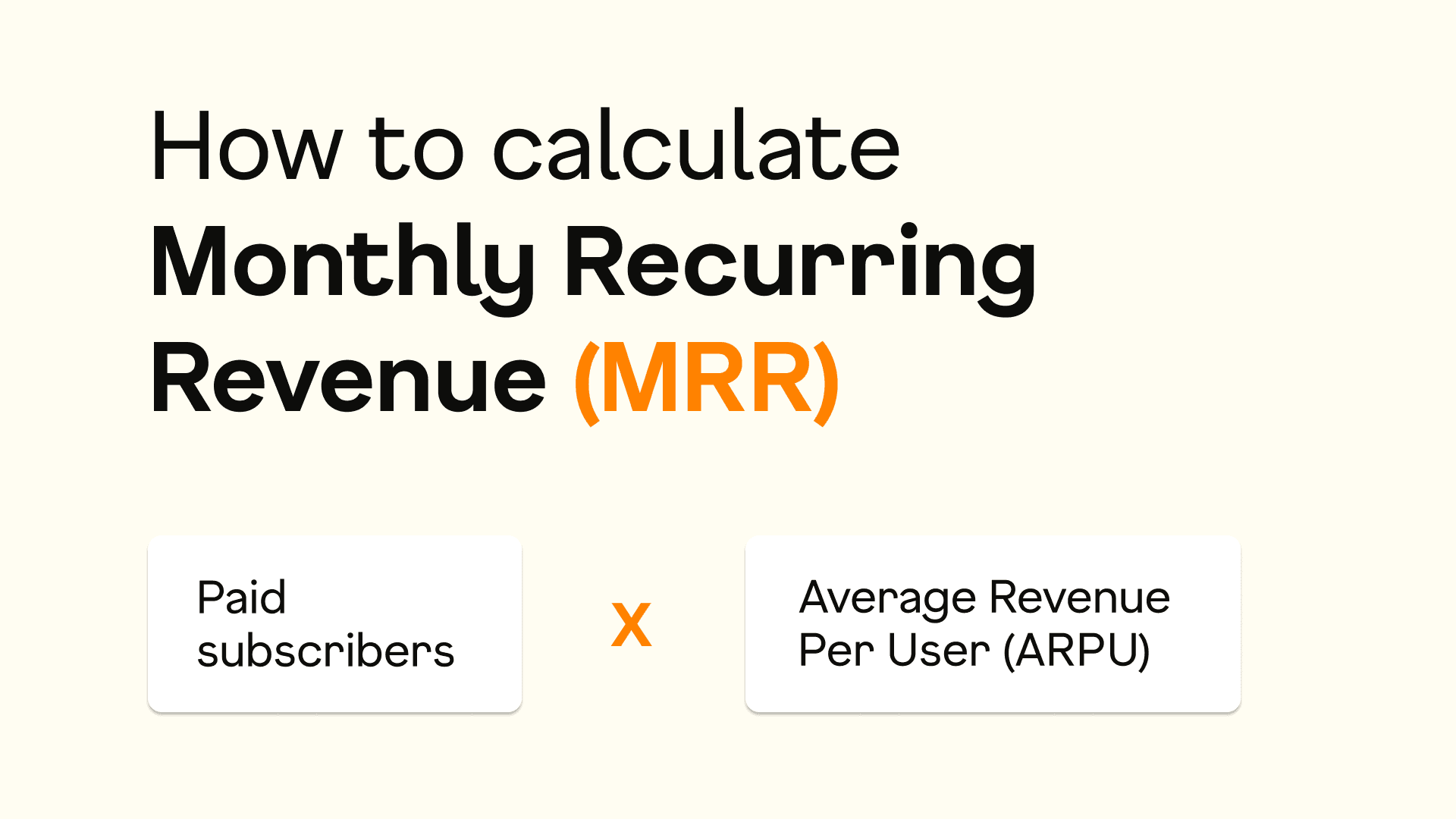
To calculate your MRR, take your total number of paid subscribers and multiply it by the revenue per user that month. Let's say you have two hundred subscribers paying thirty five dollars a month for your service. Your MRR would be seven thousand dollars. As MRR only considers recurring revenue, exclude month to month contracts with no auto renewals and one time charges.

Calculating MRR might seem simple, but there are a lot of factors to consider.

Like new MRR, which is the money from new subscribers, expansion MRR, which is the money from cross sells or upsells to your existing customers, and churn MRR, which is the impact of cancellations and downgrades.

To find your ARR, multiply your MRR by twelve. So using this same example, it would be eighty four thousand dollars.

ARR can be easily reported if you sell only annual contracts. To do so, divide the total contract value by the number of years. For example, if a customer signs up for a three year contract for six thousand dollars, divide six thousand dollars by three. This gives you an ARR of two thousand dollars.

If both of these metrics are tracking recurring revenue, then how does MRR differ from ARR? A monthly recurring revenue report allows you to measure the impacts of any marketing strategies and view revenue fluctuations throughout the year. Whereas an annual recurring revenue report gives you year over year financials to improve long term planning. Additionally, valuations for SaaS companies are typically based on multiples of ARR.

Relying on a subscription management and recurring billing platform can remove the burden of manual calculations. Recurly's monthly recurring revenue dashboard, for example, checks total MRR and MRR changes to help you evaluate your business's growth and revenue momentum.

To request a free demo, visit Recurly dot com.
So why should your subscription business care about ARR?
When your business collects revenue from subscriptions, ARR tells you your annual basis revenue based on what you expect to receive from your customers.
ARR is a metric that helps you better understand your company's growth.
By evaluating your subscription model using ARR, you can better forecast budgeting, customer lifetime value, net revenue retention and more.
When you break down annual recurring revenue into components such as ARR from current customers' upgrades and ARR from new customers, you better understand what factors are contributing the most to your revenue.
ARR vs. MRR vs. NRR
ARR: Measures recurring revenue on a yearly macro level. It is best used for year-over-year long term financial planning.
Monthly recurring revenue (MRR): MRR is calculated monthly and provides immediate insight into specific changes in your strategy. For example, monitoring if a plan change or subscription offering is effective at boosting acquisition.
Net Revenue Retention (NRR): Measure the revenue retained from existing customers after accounting for customer churn, downgrades, and upgrades. NRR provides insights into the expansion or contraction of revenue from the existing customer base.
Key differences between ARR vs. MRR
ARR and MRR measure the same thing, but on different timetables. For example, a company with $120,000 in ARR has $10,000 in MRR. If MRR starts declining mid-year, that's a signal ARR won't hold — something you'd miss looking at annual figures alone.Therefore, ARR offers greater long-term insight, which is critical for both your company's management and investment opportunities. MRR allows you to dive deeper, so you can see the immediate effects of any changes or developing strategies. It also allows you to view subscription revenue fluctuations at different times within a one-year period.
What NRR adds
While ARR and MRR tell you how much revenue you have, NRR tells you how healthy that revenue is. An NRR above 100% means existing customers are spending more over time which is a strong signal of product-market fit and additional growth. A high NRR indicates a company's ability to retain and upsell existing customers.
Why do you need ARR, MRR, and NRR?
Collectively, ARR, MRR, and NRR enable a comprehensive evaluation of a company's financial health and growth trajectory. Strong ARR indicates a stable revenue stream, while consistent growth in MRR signifies a healthy sales performance. Additionally, a high NRR highlights efficient customer retention and revenue expansion. These metrics help analysts and investors assess the company's financial stability, sustainability, and potential for future growth.
How to calculate ARR to measure your business health
To calculate ARR, divide the total annual contract value by the number of years. However, consider that not every business will use the same annual recurring revenue calculation. Your business's ARR formula depends on several factors, including the complexity of your subscription business model.
While calculating ARR, keep the following in mind:
ARR only considers recurring revenue. This means you must exclude any variable or one-time charges in the same period of time, like one-off item orders.
ARR is intended to assist you in developing a detailed understanding of the momentum around your company's ARR from new customers, existing customers who renew, incremental increases (add-ons and upgrades), and ARR losses (downgrades, lost customers, revenue churn).
Have a clear definition of ARR within your organization based on your subscription terms, especially if your subscriptions run for a non-standard period—for example, 15 months instead of 12. As long as your records stay consistent regardless of how you structure payments, billing cycles for annual subscriptions (or longer) shouldn't affect your ARR.
Since one-time fees are considered non-recurring revenue, they are almost always excluded from calculating ARR.
Subscription ARR Formula
ARR = (annual subscription cost + recurring revenue from add-ons and upgrades) - lost revenue from cancellations.
ARR formula examples
If a current customer signs up for one of your multi-year subscriptions, you will divide the contract's revenue by the contract term length. Take a 3-year contract for $5,500 and divide $5,500 by three. This gives you an ARR of $1,833.33.
To calculate decreases, take the same approach. For example, if a customer does not renew a $8,000 contract over two years, divide $8,000 by 2 for an ARR decrease of $4,000.
Here is an example based on a three-tier plan structure.
Basic costs $5.99/month, standard costs $10.99/month, and premium costs $13.99/month
If a customer purchased the basic plan for three months before upgrading to premium, the monthly subscription price would increase from $5.99 to $13.99
You can then calculate the total dollar amount of the customer's yearly subscription: $5.99 x 12 months = $71.88
This total is then added to the amount gained through the upgrade: $8 (the difference between the two plans) x 9 months (the remaining period that the upgrade applies) = $72
In this case, there is no dollar amount lost because of cancellations (churn).
The total ARR is $71.88 + $72 = $143.88
If you have focused your attention on building a pricing strategy based on your MRR, here is how you'd find your ARR.
MRR = MRR at the beginning of the month + MRR gained from new customers that month + MRR gained from upgrading customers that month - MRR lost from downgrading customers that month - MRR churn for that month
MRR x 12 = ARR
Who should use the Annual Recurring Revenue model?
The ARR Model is best-suited for subscription businesses. When determining if you should use this model, consider the term length of your customer subscriptions. Using an ARR Model is ideal when you have committed long-term subscription customers compared to short-term subscription contracts. Since ARR calculates revenue generated by the customer over the course of a year, having long-term subscriptions makes the calculation more accurate.
Additionally, businesses with recurring revenue streams benefit most from the ARR Model. Companies that rely on a steady and predictable revenue stream, rather than one-time sales, can effectively use this model.
What are the benefits of calculating ARR for SaaS businesses?
To make more informed decisions, you need to understand the health of your subscription business over time.
Whether you are planning the development of new products or upgraded feature releases, re-evaluating the market, or focusing on expansion revenue, knowing the impact of your decisions is vital.
Calculating annual recurring revenue is one of the most effective methods of gaining that insight, as it:
Provides deep insight for growth prospects: ARR is the amount of revenue you expect to repeat, which will help you better predict future growth. When you look at data over a 12-month period, you can easily see the impact of any changes you made throughout the year.
Predicts future revenue: When you are aware of your revenue and the cost of lost customers, you can better manage expenses and maintain a positive cash flow. ARR is the foundation of more complex calculations, such as those that determine acquisition goals, pricing, and churn percentages.
Shows the health of your business: By including only the actual revenue you generated in a year, you create an accurate picture of how your business is doing and what that means for the year ahead.
Helps you set more realistic goals: When you stay informed, you can make better decisions. ARR offers guidance for the future, showcasing available opportunities based on the actions that will have the greatest impact.
ARR metrics and KPIs to measure
There are some key ARR benchmarks that act as key indicators of your company's health and growth, financial performance, and sustainability:
1. ARR growth rate: This measures the year-over-year increase in your company's ARR over time. A high growth rate indicates a positive trajectory and implies that your company is acquiring new customers or expanding the customer base effectively. A strong ARR growth rate suggests that your company is on a path of continuous revenue growth and can help you understand how to maintain that growth for the long term.
2. Net revenue retention (NRR): NRR reflects your company's ability to retain and expand your existing customer base. An NRR above 100% implies that your company is successfully upselling or cross-selling to your current customers, resulting in increased average revenue over time.
3. Customer acquisition cost (CAC) payback period: CAC Payback Period examines the time required for your company to recoup the customer acquisition expenses. It evaluates the efficiency of your company's sales and marketing efforts by comparing the cost of acquiring a customer to their revenue generation. A shorter payback period means your company is acquiring profitable customers quickly.
4. Churn rate: This metric measures the rate at which customers cancel or unsubscribe from your service over a specific period. A high churn rate can result in a substantial loss of revenue, while a low churn rate contributes to revenue stability and growth. When customers cancel their subscriptions, they stop contributing to your annual recurring revenue, leading to a decrease in ARR.
5. Lifetime value to customer acquisition cost ratio (LTV:CAC): Customer Lifetime Value is an estimate of the total revenue a company can expect to earn from a user over the entire duration of their subscription. Churn rate plays a significant role in determining CLV, as customers who churn early contribute less to ARR and CLV than long-term subscribers. The ratio of LTV to Customer Acquisition Cost measures the relationship between the lifetime value of a customer and the cost to acquire them. A higher LTV:CAC ratio is desirable, as it signifies that your company can generate significant revenue from each customer acquired for sustainable growth.
Overall, these ARR benchmarks provide crucial insights into your company's financial performance, growth potential, and ability to retain customers to help your team make more strategic decisions and goals.
ARR FAQ
Should one-time fees be included in ARR?
No, ARR should only include recurring revenue.
Variable or one-time charges, such as setup fees or one-off item orders, are considered non-recurring and should be excluded from the calculation
Can I calculate ARR if I only track MRR?
Yes, you can find your ARR by multiplying your total Monthly Recurring Revenue (MRR) by 12. To get an accurate MRR figure first, start with your month-beginning MRR, add gains from new or upgrading customers, and subtract losses from downgrades or churn.
What is a "good" ARR metric to track for growth?
The ARR growth rate is a vital benchmark, as a high rate indicates your company is effectively acquiring new customers or expanding its current base. Other essential benchmarks include Net Revenue Retention (NRR), which should ideally be above 100%, and the LTV:CAC ratio, which measures the relationship between customer lifetime value and acquisition costs.
Is ARR the same as annual contract value (ACV)?
No, ACV refers to the average value of a subscription per subscriber. ARR refers to the annual subscription revenue for the year.
What is the difference between ARR and revenue?
ARR is the annual recurring revenue from subscriptions excluding one-time purchases/one-off sales. ARR helps with long term planning and forecasting. Revenue is going to include all types of purchases after services have been delivered. For further follow-up you can check out this article here.
Recurly fuels the growth of subscription model businesses
Recurly is a subscription billing and management platform designed to fuel your rapidly growing subscription business.



