
December 3, 2025
Customer winback strategies for subscription success

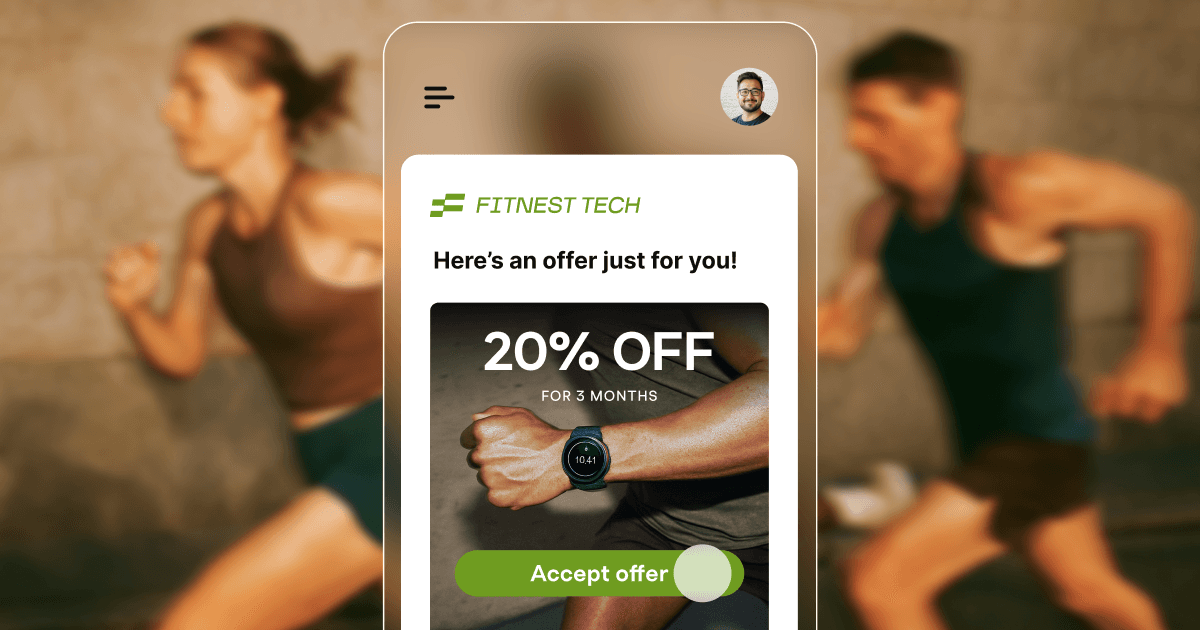
TABLE OF CONTENTS
TOPICS
RELATED POSTS
A win-back campaign is a targeted marketing initiative designed to reactivate lapsed or canceled subscribers. These campaigns focus exclusively on high-intent former customers who have already demonstrated product familiarity. These customers are more familiar and more likely to come back to the product rather than winning over an entirely new customer.
Acquisition rates dropped from 4.1% to 2.8% between 2021 and 2024, making it more challenging and more expensive to acquire customers. Meanwhile, churned subscribers who already know your product, trust your brand, and have billing information on file simply disappear.
These former customers represent lost monthly recurring revenue (MRR) and wasted acquisition spend.
To back this up, 20% of new acquisitions actually come from returning subscribers in 2025, which means competitors who run winback campaigns are stealing back the customers you let go.
A customer winback strategy turns churned subscribers into an opportunity. By re-engaging former customers with targeted campaigns, you can recover lost revenue at a fraction of the cost of new acquisition.
Key takeaways
Segmentation matters: Success comes from prioritizing high-value, "winnable" subscribers rather than blasting every canceled account with the same message
Context is key: Understanding why a customer canceled allows you to send personalized offers that address their specific pain points
Timing counts: Automated sequences that launch immediately after a grace period ensure you stay top-of-mind before the customer finds a competitor
What is customer winback?
Customer winback or customer winback campaign is a marketing strategy designed to re-engage subscribers who have canceled their service or become inactive and convert them back into paying customers. Unlike retention strategies, which aim to prevent churn before it happens, winback campaigns focus on repairing the relationship after the break-up.
These campaigns typically utilize email sequences, retargeting ads, or direct outreach to remind former customers of the value they are missing. In the subscription economy, where relationships are cyclical, winback is less about "sales" and more about demonstrating that you have improved the product or solved the problem that caused them to leave in the first place.
The different types of winback campaigns
Treating all canceled accounts identically dilutes offer relevance and hurts conversion metrics. You need a specific type of campaign per segment of customers who churn.
Involuntary churn recovery: This campaign targets subscribers lost to passive churn, such as expired credit cards or failed payment processing. These flows rely on automated dunning, account management notifications, and immediate in-app messaging rather than promotional discounts.
Active cancellation reactivation: This variation focuses on customers who intentionally canceled their service. Reactivation efforts require tailored incentives. Plan flexibility, feature tier upgrades, or temporary pricing promotions are best suited to these customers.
Milestone-driven re-engagement: These campaigns trigger at specific intervals following account closure, typically at the 30, 60, and 90-day marks. Timing determines the type of incentive. Sometimes these can be bundled with active cancellation.
Why customer winback matters for subscription businesses
Acquiring a new customer costs 5 to 25 times more than retaining an existing one, making winback campaigns one of the most cost-effective growth levers for subscription businesses.
Churned or paused subscribers generated over $200 million in re-subscription revenue
As subscriber growth continues at 15.4% while acquisition rates decline, winback and retention have become the new engines of growth. Losing a subscriber creates a double impact: the immediate loss of MRR and the long-term loss of customer lifetime value (CLV).
Former subscribers are uniquely primed for reactivation. They already trust the brand, know the product, and often still have billing information on file, lowering the friction to return.
Some industries are leading the way. The Return Acquisition Percentage (RAP) is especially strong in:
Digital media: 24.3%
Travel, hospitality, and entertainment: 22.9%
Subscriptions in these spaces are naturally cyclical. Customers frequently come back when life circumstances shift or when new content, features, or benefits draw them back in. If you aren’t proactively inviting them to return, you’re leaving money on the table.
Which churned subscribers should you target?
Not every churned customer is worth pursuing. To get the best return on your winback efforts, target segments based on data—not a broad, blanket approach.
Start by segmenting churned subscribers by customer lifetime value (CLV) prior to cancellation.
High-value, long-tenured subscribers are worth greater outreach effort
Low-value, one-off subscribers (e.g., discount seekers) offer far lower ROI
Next, evaluate engagement levels leading up to churn:
Highly active users who suddenly left often churned because of a specific, solvable issue (pricing, missing feature, poor timing)
Dormant users typically never found strong value, making them less likely to return
Then, analyze churn reasons and prioritize “winnable” categories:
Good targets: users who left due to something you’ve fixed like bugs, pricing concerns, friction in the experience
Poor targets: users who left due to reasons you can’t control (moved, business closed, no longer need the service)
Use subscription analytics to identify which segments deliver the highest ROI, and concentrate your winback budget on those most likely to return.
Understanding why customers cancel
Before building any winback campaign, you need clear insight into why subscribers left. Without this context, messaging becomes generic and ineffective.
Gather churn reasons at the moment of cancellation using a simple, one-question exit survey. Examples include pricing, lack of use, bugs, missing features, or frustration with the experience.
Use these insights to personalize winback messaging:
Price-related churn = targeted discount or credit.
Technical frustrations = highlight fixes or performance upgrades.
Missing features = announce new releases or roadmap updates.
Identifying patterns not only improves winback effectiveness but also strengthens future retention efforts. By categorizing reasons into "fixable" vs. "permanent," you can tailor your strategy to address the objections that actually matter.
6 Proven customer winback strategies
Recovering revenue requires more than a generic “We miss you.” Here are six tactical approaches that actually move the needle.
1. Send personalized winback email campaigns
Email is still the highest-ROI channel for winback efforts, but generic blasts rarely work.
Personalization dramatically improves conversion:
Reference their tenure or past purchases
("You were with us for two years") / ("We know you loved our mystery thrillers")
Use their name and acknowledge your existing relationship.
Crucially, make the reactivation process simple. If they have to fill out a long signup form again, you will lose them. Use "one-click" reactivation links whenever possible to remove friction.
Win back email example:
Consider an example like this one
Subject: We've upgraded your experience. Come see what's new.
Hi [Name],
We updated our platform based on user feedback. Your account now includes expanded capacity, faster processing speeds, and advanced analytics dashboards designed to accelerate your growth workflows.
Reactivate your subscription today to explore these new capabilities with a 14-day complimentary trial.
[Reactivate My Account]
Consider using AI to generate multiple versions of your template so you can A/B test their effectiveness over time based on the specific persona. Recurly’s State of Subscription report revealed that 1 in 4 new subscriptions now come from a previously canceled subscriber, making your lapsed user base one of your most cost-effective and highest-converting acquisition channels.
Furthermore, embedding alternative options directly into the cancellation flow acts as an immediate churn buffer. Subscription businesses deploying "pause before cancel" choices saw a 337% surge in pause usage, with 75% of those pausing customers eventually returning to active billing status.
Budget conscious winback email example:
For the budget conscious shopper, here's an example you can follow:
Subject: Return today and save 20% on your next 3 months
Hi [Name],
Managing subscription budgets shouldn't stall your operations. We want to help you resume your workflows seamlessly without breaking your financial run rate.
Rejoin our network this week to receive an automatic 20% discount on your next three billing cycles.
[Claim Your Discount]
2. Offer time-limited incentives that create urgency
Incentives work best when they’re strategic, relevant, and time-bound.
Test dollar-off vs. percentage discounts to see what resonates ($20 vs. 20%)
Non-discount incentives also work well:
Free month
Bonus loyalty points
Exclusive feature access
Use deadlines to drive action:
“Redeem your $20 credit before Friday.”
Tailor the value of the incentive to the customer's previous value. A high-LTV customer who spent thousands with you deserves a more aggressive offer than a low-LTV customer.
3. Highlight product updates and new features
Subscribers who left because your product was missing a key feature or had performance issues are prime candidates for this strategy. When you release a major update, bug fix, or new capability, use it as a hook to re-engage these specific former customers.
Send update-focused winback messages that directly address past pain points.
Example: “You asked for better reporting. Here’s our new Analytics Dashboard.”
This approach makes customers feel heard and valued. It positions the update not just as a feature release, but as a direct response to their feedback. Link to a product roadmap or changelog to show that the product is constantly evolving, giving them a compelling reason to give your service another try.
4. Use retargeting ads to stay top of mind
Email is powerful, but it’s easy to ignore. You need an omnichannel approach.
Retarget churned customers across social and display networks.
Use dynamic creative reflecting:
Past purchases
Categories browsed
A “come back” offer or new feature highlight
Retargeting is particularly effective for customers who stopped engaging with your emails before they canceled. Since ads cost more than email, measure your return on ad spend (ROAS) carefully. Test different formats, whether they be GIFs, static images, carousels, and videos to see what captures attention best.
5. Send multi-touch winback sequences
A single email is easy to miss. To maximize recovery, build a sequence of 2–4 emails with strategic time delays between messages.
Email 1 (The nudge): Acknowledge the relationship, express that you’ve missed them, and remind them of the value of the subscription
Email 2 (The offer): Present a specific incentive or highlight a major product improvement that solves a known pain point
Email 3 (The urgency): Remind them that the offer is expiring soon. Create a fear of missing out (FOMO)
Email 4 (The breakup - Optional): A final, polite outreach before you remove them from the sequence
Include conditional logic in your automation. If a user clicks a link in email 1 but doesn't convert, send a different follow-up than you would to someone who never opened the email. Generally, stop sending after 3–4 attempts to maintain your sender reputation and respect the user's inbox.
6. Reach out personally to high-value customers
VIP customers deserve more than automation.
Have Customer Success, or even an exec, send a personal note
Skip HTML templates; make it look like a real email from a human
Ask directly what you can do to earn their business back
Offer a quick call to resolve issues
Even if they don't return immediately, this level of personal care leaves a lasting positive impression and can yield valuable feedback. Document their responses to improve retention of your current customer base.
How to build a customer winback campaign
Implementing a winback strategy requires coordination between your data, marketing, and subscription platforms. Follow these steps to build a campaign that converts.
Step 1: Segment your audience. Don't treat all churned users the same. Group them by value (high vs. low LTV), tenure, and cancellation reason.
Step 2: Set up automated triggers. Determine when the winback sequence should start. This might be 30, 60, or 90 days after cancellation, depending on your product's lifecycle.
Step 3: Create personalized sequences. Draft your email copy for each segment. Ensure the messaging aligns with why they left.
Step 4: Design your incentives. Assign specific offers to each segment. Remember, high-value segments justify higher acquisition costs.
Step 5: Set up tracking. Ensure you can track opens, clicks, and—most importantly— reactivations. You need to know exactly which email drove the conversion.
Step 6: Test and iterate. A/B test your subject lines, offer types, and timing. Does a 30-day delay work better than 60? Does "$10 off" convert better than "Free month"?
Step 7: Measure and optimize. Review your data regularly. Double down on the segments and offers that bring back the most revenue.
Measuring customer winback success
To justify the resources you put into winback campaigns, you need to measure the ROI accurately.
The primary metric to track is the Reactivation Rate, calculated as: (Churned customers who return / Total churned customers targeted) x 100
Beyond the rate, track Reactivation MRR — the actual monthly revenue generated by those returned subscribers. You should also monitor the Customer Lifetime Value (CLV) of reactivated subscribers to ensure they stick around. If customers return for a discount and churn again immediately, your campaign may be losing money.
Compare the cost of your winback campaigns against your standard Customer Acquisition Cost (CAC). In almost every case, winback costs should be significantly lower. Finally, monitor Second-Time Retention. How long do these reactivated customers stay? This data helps you refine your strategy to ensure you are winning back high-quality customers, not just bargain hunters.
Common customer winback mistakes to avoid
Even with the best intentions, winback campaigns can fail if they are poorly executed. Avoid these common pitfalls:
Treating everyone the same: Sending a generic "We want you back" email to a VIP customer who left due to a technical failure is insulting. Lack of segmentation kills conversion
Waiting too long: If you wait six months to reach out, they have likely found a replacement. Strike while the brand memory is fresh
Using impersonal messaging: "Dear Subscriber" signals that you don't know who they are
Over-discounting: If a customer left because of product fit, a discount won't fix the problem. Offering discounts to everyone also devalues your brand
Complicating the return: If they have to re-enter all their data, they will bail
Oversending: Bombarding a churned user with daily emails will get you marked as spam, hurting your deliverability for active customers
Ignoring feedback: If you win them back but haven't fixed the problem that caused them to leave, they will just churn again
When to stop pursuing churned customers
There is a fine line between persistence and harassment. Knowing when to let go is just as important as knowing when to reach out.
Generally, if a user hasn't engaged after 3–4 winback attempts, it is time to stop. Continuing to email unengaged subscribers hurts your overall email deliverability rates.
Respect customers who have moved on. Send a final "breakup" email acknowledging that you will stop contacting them — sometimes, this final "takeaway" creates a reverse psychology effect that drives a click. Always offer an easy unsubscribe option.
Focus your resources on the customers who show interest. Maintain list hygiene by removing truly inactive subscribers from your campaign flows. If the cost of the campaign exceeds the revenue it generates, the ROI is negative, and it’s time to sunset that specific effort.
Using Recurly to automate customer winback
Recurly removes the manual work and makes winback systematic.
Captures churn reasons automatically, enabling clean, accurate segmentation
Triggers personalized campaigns through integrations with major email and CRM tools
Tracks Reactivation MRR and CLV directly in the dashboard
Identifies at-risk customers before they churn, then automates follow-up if they do
Helps you close the loop on the entire subscriber lifecycle—from churn to recovery
Common win-back questions
What is a win-back campaign?
A win-back campaign is a targeted initiative designed to reactivate lapsed or canceled subscribers who previously paid for a service. These campaigns leverage historical user data to deliver relevant messaging that encourages account reactivation.
How do you win back customers?
You win back customers by identifying the specific cause of churn, segmenting users based on their exit behavior, and delivering automated, timely offers. Addressing core objections, whether they be price, utility, or technical friction, is critical to successful reactivation.
What should a win-back email include?
A win-back email must include a clear value statement highlighting recent platform improvements or economic incentives, a direct call-to-action to reactivate, and a frictionless path to account restoration. Eliminating login barriers during checkout significantly improves conversion.
What makes a win-back strategy effective?
An effective strategy relies on automated timing windows, precise customer segmentation, and offering operational flexibility before a user exits. Recurly network benchmarks demonstrate that providing a "pause" alternative captures high-intent users early, with 75% of those paused subscribers eventually returning to active billing status.
Ready to automate your subscriber recovery workflows? Talk to a Recurly expert today to see how built-in lifecycle management tools can systematically lift your net revenue retention.



