February 4, 2026
How loyalty as a service is redefining subscriptions


TABLE OF CONTENTS
TOPICS
RELATED POSTS
While every business strives for customer loyalty, you cannot expect lasting commitment without providing the right incentives. If you fail to reward your customers, they will have little reason to remain devoted to your brand. Most companies see loyalty efforts as a last ditch effort to stop a subscription cancellation. But as we move further into 2026, the data tells a different story. Loyalty is no longer just about retention; it is one of your most powerful engines for acquisition.
In our 2026 State of Subscriptions report, we identified a fundamental shift in how successful brands view their subscribers. These systems are being recognized as Loyalty-as-a-Service (LaaS).
Here is how the LaaS model changes the game, and why your tech stack needs to be ready for it.
Defining Loyalty-as-a-Service
LaaS models integrate reviews, advocacy tracking, and subscriber behavioral data to transform basic engagement into actionable business value.
In simple terms: old loyalty was about keeping a customer quiet and paying. LaaS is about turning every satisfied user into a vocal core component of your brand’s growth strategy. It’s about using engagement as a metric to drive retention which ultimately helps brands grow in competitive markets.
But you cannot build a LaaS model on a shaky foundation.
What is needed for loyalty as a service?
Before a subscriber is willing to advocate for your brand, they first need to trust you.
Our 2026 data reveals a stark hierarchy of needs for modern subscribers. While marketers often obsess over "delight" features like community perks or brand purpose, the data shows that subscribers are far more pragmatic.
When asked what motivates their loyalty, the number one answer wasn't community (25%) or ethical practices (12%).
The top factor, at 44%, was "Transparent billing with no hidden fees."
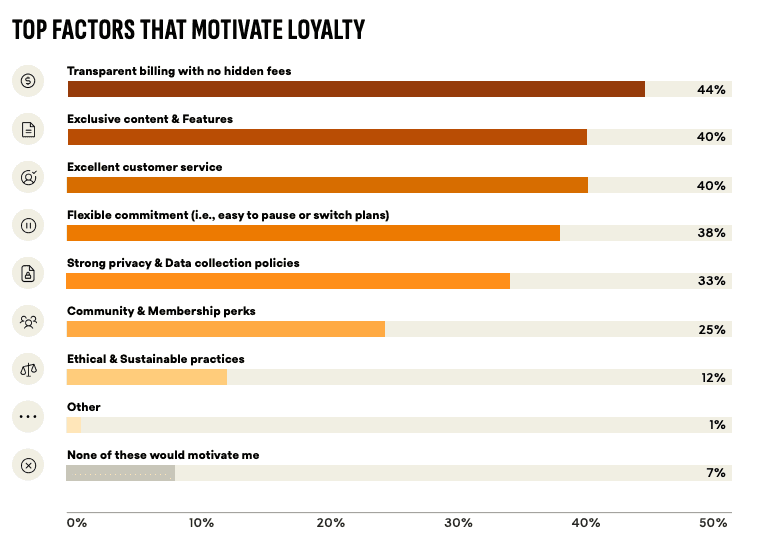
Clear pricing, the right exclusives, and solid customer service are the bedrock to motivate loyalty. On top of these, you can build the right layers — including perks, flexibility in points or services, and limited-time deals. Get the basics right, and these added benefits just reinforce the value prop in a consumer economy focused on pragmatism.
The lesson for LaaS: you cannot ask a customer to be a partner in your growth (LaaS) if they are anxious about their invoice. "Bill shock" is the fastest way to erode the trust required for advocacy. To activate a LaaS model, you must first ensure your billing is seamless and completely transparent.
How does LaaS engine drives revenue?
Traditional loyalty programs are passive; they wait for a customer to redeem points. A LaaS framework is active. As highlighted in our report, it works by integrating three critical data streams: subscriber behavioral data, integrated reviews, and advocacy tracking.
Here is how these components work together to turn a satisfied user into a growth engine:
1. Behavioral data as the trigger
Instead of sending generic "rate us" emails based on a calendar date, LaaS uses behavioral data to identify the perfect moment to engage.
Old way: Send an NPS survey 30 days after signup.
LaaS way: Trigger a request for a review immediately after a user successfully completes their first major project using your software, or after they binge-watch an entire season of content. You strike when satisfaction is highest. You’ll need to A/B test this for maximum effectiveness.
2. Moving reviews out of the support silo
In many organizations, customer reviews get buried in support tickets. LaaS integrates this sentiment directly into the marketing funnel. A glowing review from a verified, long-term subscriber isn't just a pat on the back for the CX team; it’s a high-converting marketing asset that should be instantly leveraged on checkout pages, acquisition campaigns, and across platforms.
3. Tracking true advocacy
LaaS involves understanding the influence of your subscriber base. Who are the users whose recommendations actually convert new business? By tracking this advocacy, subscription businesses can offer meaningful, non-monetary rewards — like early access to features or direct access to product teams — that deepen the connection with these critical "micro-influencers.”
Common tools for LaaS: The "pause" and the "return"
The most radical shift in the 2026 LaaS model is the acceptance that loyalty does not always mean "continuous payment." In the modern subscription economy, loyalty is a loop, not a straight line.
To maximize growth, brands must combine flexibility with reactivation.
The power of the pause
Brands often fear making it easy to leave, but the data proves that flexibility actually saves revenue.
38% of consumers say they prefer pausing over canceling.
Merchants who offered a "pause" option saw usage increase by 337%.
By offering a pause, you keep the subscriber in your ecosystem. You are not losing a customer; you are servicing their need for financial flexibility. Moreover, you can set rewards for pausing rather than cancelling, improving the value proposition for the customer.
The "boomerang" effect
Even when a customer does cancel, the relationship isn't over. Our report found that nearly 1 in 4 new subscriptions now come from a previously canceled customer.
This changes the definition of success. A "churned" customer is no longer a failure; they are simply a high-intent lead for next quarter.
The LaaS takeaway: Don't burn the bridge. If you treat departing customers with respect — offering pauses or easy cancellations — you build the trust required to win them back. As Brian Gregory from Chegg notes, "“If your customers canceled in the past, there was a reason for it, and you better know that reason. Otherwise, you're going to miss out on the chance to bring them back.”
Conclusion: Is your tech stack ready?
The data is clear: The subscribers of 2026 demand flexibility, transparency, and value. In return, they are willing to become more than just payers — they become your brand advocates pushing for greater adoption among communities.
But this requires a shift in infrastructure. You cannot simply "turn on" Loyalty-as-a-Service if your billing data is siloed from your marketing tools, or if your retention strategy is limited to a "cancel button."
If your subscription business is still treating loyalty as a defensive "churn prevention" tactic, you are leaving growth on the table. It’s time to upgrade to Loyalty-as-a-Service. Want to learn more?