
December 3, 2025
How user journey mapping for subscriptions apps can improve engagement


TABLE OF CONTENTS
TOPICS
RELATED POSTS


We have all been there. You download a new app that promises to solve a problem or provide entertainment. You open it up, ready to dive in, but within three minutes, you are confused by the interface or stuck on a sign-up screen. You close the app, and eventually, delete it.
For subscription businesses, that moment of friction is the enemy.
In the subscription economy, acquisition is only half the battle. Retaining a customer is a continuous effort that spans the entire lifecycle, from the initial signup through payment management. This is where the real work begins. To keep users coming back, you need to understand exactly how they move through your application. This is why defining your in-app user journeys becomes critical.
What is a subscription user journey?
A subscription user journey is the visual representation of every step a user takes to achieve a goal within your service. It tracks the roadmap from their perspective, detailing their actions, their thinking, and, crucially, their feelings at each interval.
In-app journey vs. complete subscriber journey
It is easy to conflate the "customer journey" with the "in-app journey," but distinguishing between the two is vital for optimization.
The complete subscriber journey: This is the macro view. It encompasses everything from the moment a user sees an ad on Instagram (awareness) to reading reviews (consideration), signing up (conversion), interacting with support tickets, and eventually renewing or churning. It covers marketing, sales, and support channels.
The app user journey: This is the micro view. It focuses specifically on the interface and flow within the application itself. It looks at which buttons they click, how they navigate from the dashboard to a feature, and where they get stuck in the UI.
While the complete journey tells you who your customer is, the in-app journey tells you how they experience your value proposition. By zooming in on the in-app experience, you can identify specific interface pain points where engagement drops off.
Why is it important to understand your subscriber journey?
You cannot fix what you do not measure, and you cannot optimize what you do not understand. Mapping the journey moves you away from guessing and toward data-driven strategy. Here is why that matters for your bottom line.
Retention and LTV

Churn often happens silently. A subscriber doesn't usually wake up one day and decide to cancel. It is a "death by a thousand cuts." A confusing menu here, a slow loading screen there, or a feature they simply couldn't find.
By optimizing the journey to be as smooth as possible, you reduce these micro-frustrations. This is especially true even when cancelling a service. A seamless experience naturally leads to higher retention, which directly boosts the lifetime value (LTV) of every user.
Targeted improvements
If you see a drop in engagement, your instinct might be to overhaul the entire app. That is expensive and risky. A user journey map acts as a diagnostic tool. It helps you pinpoint exactly where the drop-off happens. Is it during the initial credit card entry? Is it during the first tutorial? When you know the "where," you can allocate your development resources to fix that specific leak rather than reinforcing the whole ship.
Improved upselling opportunities
Timing is everything. Asking a user to upgrade to a Pro plan the second they sign up often feels aggressive. However, asking them to upgrade right after they have successfully completed a major task using your tool feels like a natural progression. Mapping the journey helps you identify these "high-five moments"— the perfect times to introduce add-ons or tier upgrades.
Maximizing feature value

Your app likely has incredible features that some users never see. A well-mapped journey ensures that users are guided to discover and adopt the key features that deliver your app’s core value. If they don't use the features, they won't see the value, and they certainly won't renew.
How to create a user journey map
Creating a map might sound daunting, but it doesn't require a degree in cartography. It requires empathy and logic. Here is a straightforward framework to get started.

Define scope & persona
Do not try to map every user type at once. Start by choosing a specific user persona (e.g., "The Busy Professional" or "The Budget-Conscious Student") and a clear scenario (e.g., "First-time Onboarding" or "Upgrading a Plan"). Focusing on one specific path allows for deeper insights.
Identify stages and touchpoints
Map out the sequence of steps. What is the first thing they see? What do they click next? List the actions the user takes and the channels they use at each stage.
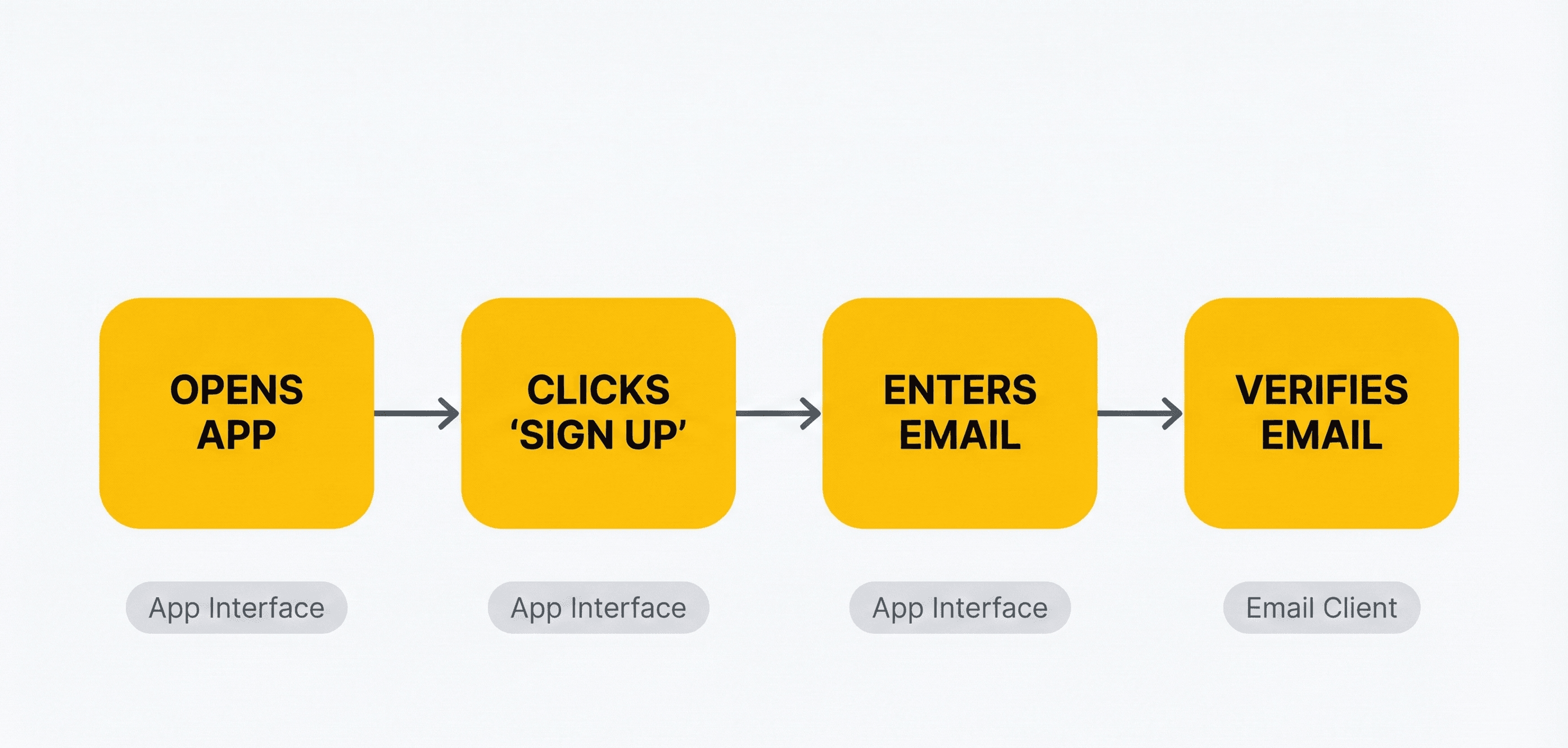
Channel: App interface -> Email client -> App interface.
Capture emotion & opportunity
This is the secret sauce of a great map. For every step, ask: What is the user feeling? Are they excited? Confused? Anxious about pricing?
The "Moment of Truth": These are the pivotal points where engagement is won or lost. For example, the moment a music streaming app successfully plays the first song is a moment of truth. If it buffers, you lose them. If it plays instantly, you win trust.
Key subscription app journey stages to map
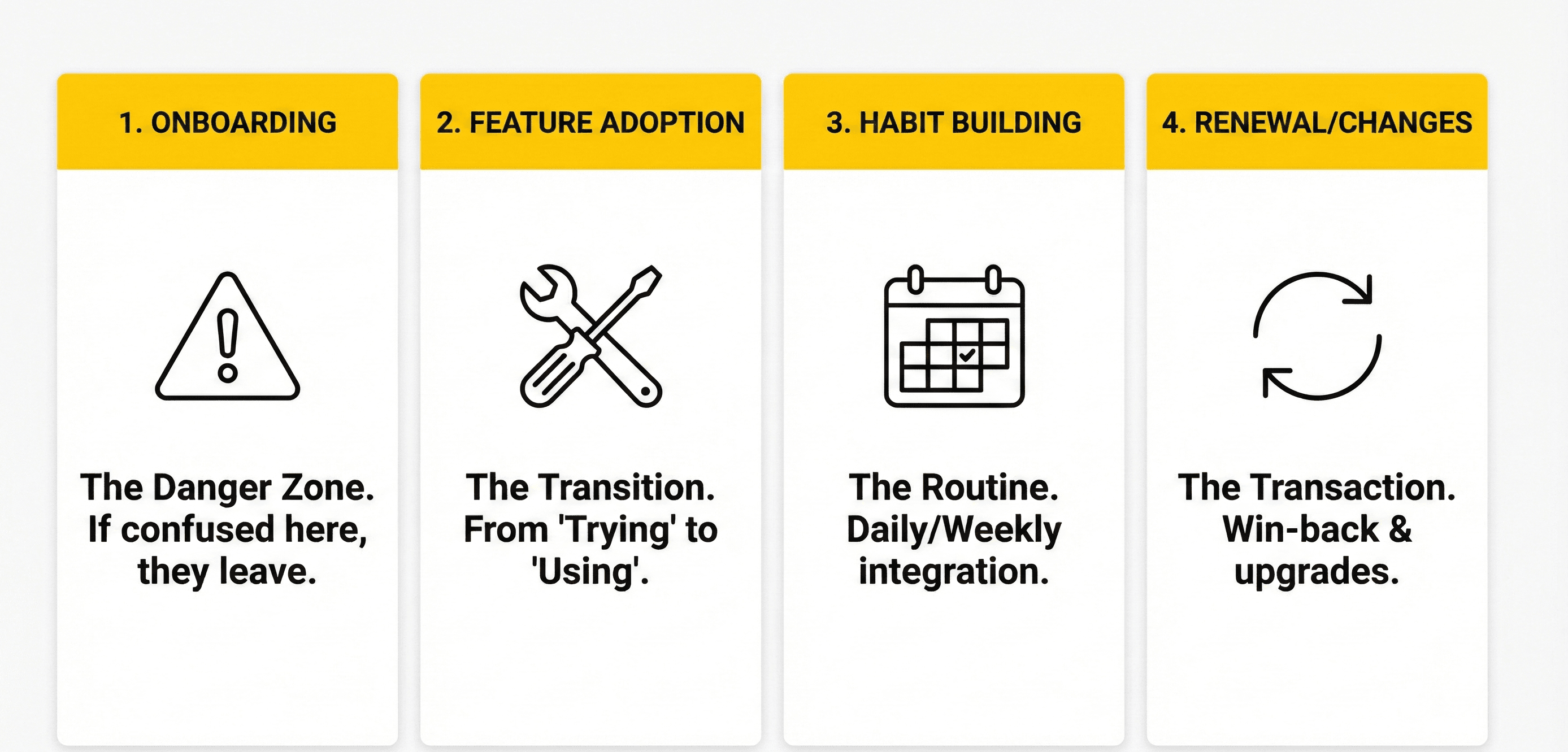
While every app is different, subscription models generally share these critical stages:
Onboarding: This is the most dangerous phase. If the user cannot figure out how to use the app in the first session, they are likely gone
Feature adoption: The phase where the user moves from "trying it out" to "using it"
Habit building: The transition where the app becomes part of their daily or weekly routine
Renewal, plan changes, and cancellations: The transactional phase. How easy is it to change a payment method? If they try to cancel, is there a flow to win them back?
Identifying pain points and optimizing for engagement
Once you have your map, it is time to look for the cracks in the pavement.
Analyze data & qualitative feedback
A map based on assumptions is just a hallucination. You must cross-reference your map with hard data. Look at your analytics: Where are the highest drop-off rates? What is the time-to-value?
Combine this with qualitative feedback. Run user interviews or send out surveys. If your analytics show that users quit on the "Profile Setup" screen, but your map assumes that step is easy, you have found a disconnect.
Focus on 'Time-to-Value'
In the subscription world, patience is thin. Look for ways to eliminate friction and unnecessary steps. If it takes ten clicks to get value, try to cut it down to three. The faster a user realizes the benefit of your app (Time-to-Value), the stickier they become.
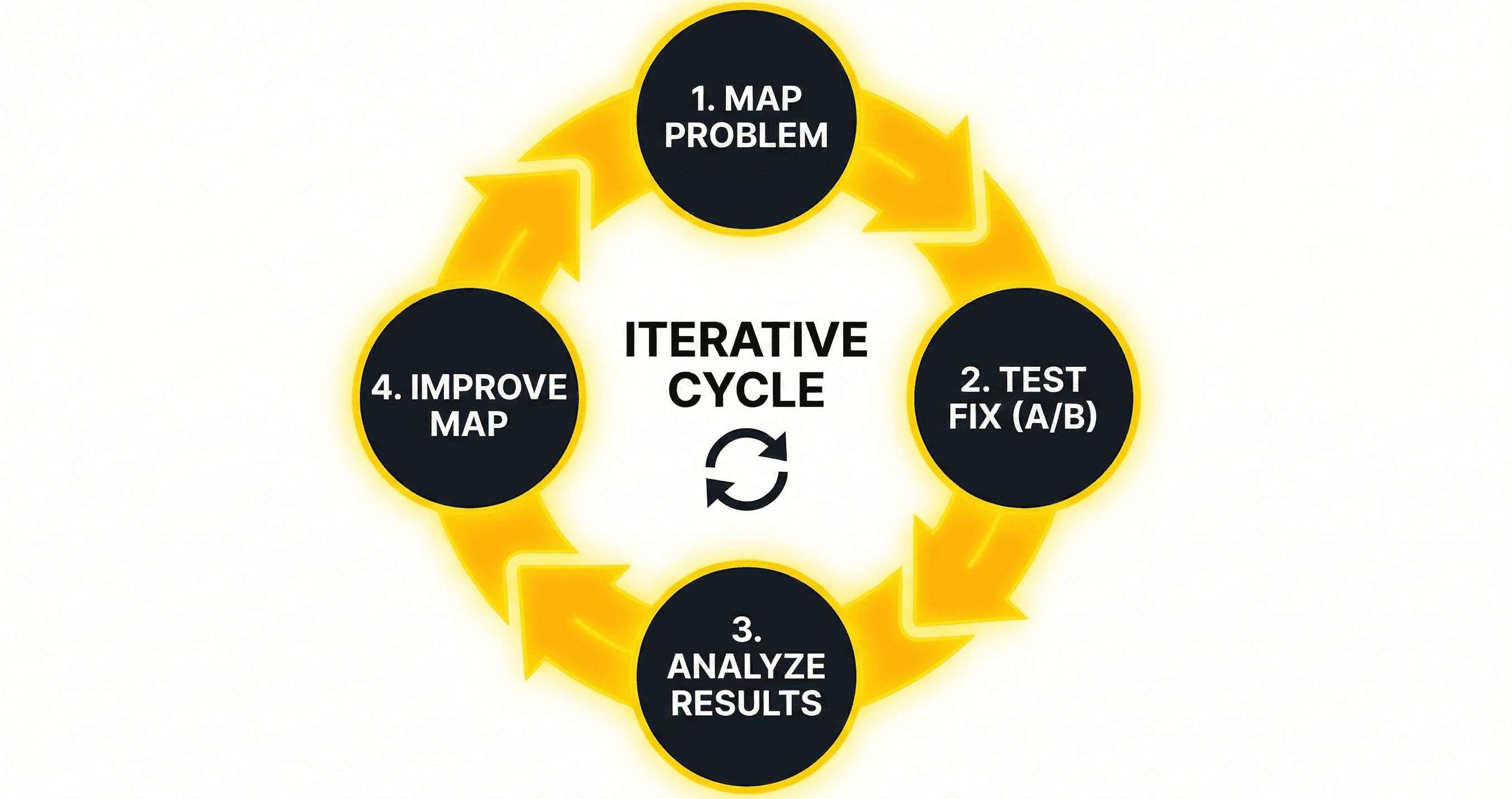
Iterative testing
Your map is never "finished." It is a living document. Once you identify a pain point, prioritize it. Then, use A/B testing to try a solution.
How Recurly Engage makes it easy to boost in-app experiences
Mapping the journey is the strategy; executing it is the tactics. This is where having the right tooling makes all the difference. Recurly does more than just process payments — we help you optimize the entire subscriber lifecycle.
With Recurly Engage, you can turn your journey insights into action:
Predict churn before it happens: Don't wait for the user to leave. Use data to identify at-risk users and trigger automated re-engagement campaigns.
Targeted cancellation flows: If a user decides to leave, Recurly helps you deploy dynamic cancellation flows that can offer discounts or pauses, saving the subscription at the last moment.
No-code journey building: You can build and test subscriber journeys without needing to pull your engineering team off core product work.
One-click subscription management: Reduce friction for upgrades and renewals, making the payment part of the journey invisible and painless.
Your app is dynamic, and your user journey should be too. By visualizing the path your subscribers take, you can pave the road to higher engagement and long-term loyalty.
Ready to optimize your subscriber journey? Learn how Recurly Engage can help you improve user engagement and journey mapping.



