
January 14, 2026
What we learned from analyzing 76 million subscribers

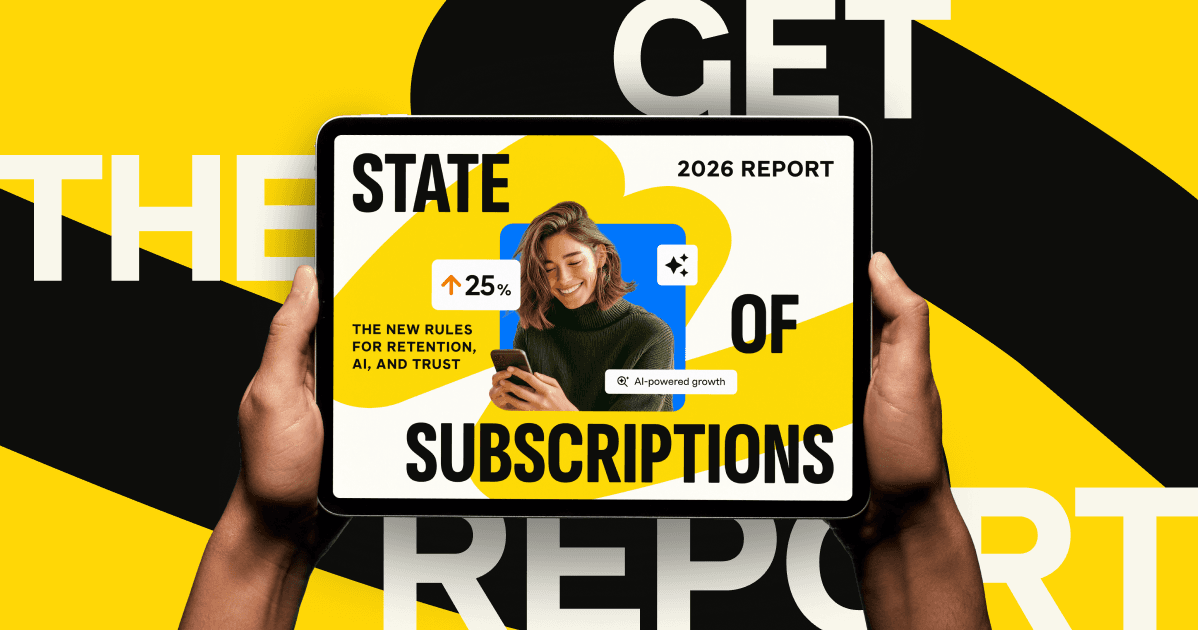
TABLE OF CONTENTS
TOPICS
RELATED POSTS


We know you're constantly balancing aggressive acquisition targets with the need to keep your current customers happy. It’s a lot to manage, especially when 52% of consumers canceled at least one subscription in the past year.
We analyzed data from 2,200 subscription businesses and 76 million unique subscribers to understand the shift happening in 2026 with our State of Subscriptions report. Our results are a wake-up call for growth leaders. The market’s focus has moved decisively from acquisition-first tactics to profitability built on the full customer lifecycle with a focus on retention.
From the surprising rise of the "pause" button to the new role of AI, here is an early look at the trends redefining the industry.
Stop making "cancel" the only option
For years, product teams debated whether to make the cancel button hard to find. That is the wrong debate. The real question is: Why is "cancel" the only off-ramp?
Our data proves that flexibility is a feature, not a bug.
The "Pause" effect:Top brands that offered a "pause before cancel" option saw pause usage increase by 337%
Retention loop: Even better, 3 out of 4 of those pausers returned within months
Think about that. If you don't have a pause option, you are forcing users who just need a break to fire you completely. Consumers have told us loud and clear: 38% prefer pausing over canceling, and this is consistent in both the US and Europe.
Implement the pause option in your cancellation flow immediately. But don't just leave it there — automate the "unpause" journey, too. We see unpause rates climb between February and April. Time your re-engagement emails to match these seasonal bounce-backs.
Friction leaves money on the table
You worked hard to get them to the checkout page. Don't let your payment processor lose the sale.
We found that payment friction varies wildly depending on where your user lives.
U.S. subscribers: Twice as likely to experience declines at signup (due to card dominance)
EMEA subscribers: Twice as likely to experience declines at renewal (due to wallet-based methods like Apple Pay)
If you are expanding internationally, you can't just copy-paste your U.S. checkout flow. You need to localize. Offer the right mix of payment methods, but be aware that while APMs (Alternative Payment Methods) convert better, they might need more aggressive dunning logic at renewal.
Volatility vs. value: The plan structure trade-off
When modeling revenue forecasts, plan mix is often treated as a preference rather than a strategic asset. However, our analysis shows that plan structure plays a decisive role in stability and lifetime value (LTV).
We see a distinct division in performance:
The annual premium: Annual subscriptions deliver steadier performance and generate 50–60% higher revenue per user compared to monthly plans. They are the bedrock of strong cash flow. However, they carry high renewal risk. When an annual plan fails to renew, the loss is significant, and recovery rates hover around 23%.
The monthly resilience: Monthly plans are more volatile and churn-prone early on, but they are highly recoverable. In fact, 53% of failed monthly payments are recovered.
Currently, 78% of merchants offer both options. The financial strategy for 2026 should be to use monthly plans as a low-risk on-ramp for acquisition, then upsell engaged cohorts to annual plans to lock in that 50–60% LTV lift.
Curious to see which industries performed better with annual vs. monthly plans? Check out the report here!
Micro-subscriptions are the new free trial
We all love a good free trial, but let's be honest: trial abusers are a headache, and conversion rates are dropping. Traditional trial conversion fell from 47% in 2021 to 34% in 2025.
Consumers are wary of committing. So, how do you lower the barrier without giving away the farm?
Enter the micro-subscription. Short-term passes — day, week, or weekend access — are filling the gap left by declining trial performance. These micro-offers are converting 13% of buyers into recurring plans.
Why does this work? Because a micro-subscription qualifies the user. Someone who pays $5 for a week of access has significantly higher intent than someone who puts in a fake email for a free 7-day trial. It’s a better signal for your product team and a healthier cohort for your retention metrics.
The psychology of "not using it"
Why do people leave? It’s not always the price.
51% of consumers say they canceled simply because they "weren't using it enough".
This sounds obvious, but it has huge implications for your product roadmap. If lack of usage is the #1 churn driver, then engagement is your #1 retention metric.
You need to intervene before they click cancel.
Usage-based triggers: If a user hasn't logged in for 14 days, trigger a specific re-engagement flow
The "AI" shift: Around 43% of consumers are comfortable with AI in their subscriptions with a specific emphasis on content personalization
Engagement predicts retention. You can’t just bill them; you also need to remind them why they bought in the first place. A strategic pop-up or well-timed offer can help increase engagement as well as drive upsells while helping you craft your strategy. Tools like Recurly Engage can help you do just that.
Want to learn more about these strategies?
Revenue recovery as a profit center
In a friction-heavy market, operational efficiency is paramount. We found that involuntary churn — payment failures, expired cards, and fraud declines — remains a massive leak in the bucket.
However, for sophisticated organizations, this is a solvable problem. Automated recovery tools like dunning, intelligent retries, gateway forwarding, account updaters, and more are not just administrative tasks; they are revenue generators.
Software companies reclaimed over $155 million in recovered revenue last year
Digital media and entertainment companies recovered around $100 million
Consumer goods recovered over $34 million
This is pure EBITDA. The data shows that industries utilizing automated recovery tools are the biggest beneficiaries. If your tech stack isn't treating failed payments as a strategic recovery opportunity, you are voluntarily lowering your margins.
And that’s just the start
The subscription economy is no longer a land grab. It is a game of efficiency, retention, and intelligent monetization. The winners in 2026 will be the companies that prioritize the subscriber lifecycle over the signup button.
Sign up now to get the 2026 State of Subscriptions report first on January 14, and if you want even more in-depth insights, check out our virtual event with guests from Audiobooks.com, Fortune, and Smallpdf to rocket to success in 2026!



