July 1, 2026
The intent gap: Why your app is missing its most critical subscription moments


TABLE OF CONTENTS
RELATED POSTS
Every time someone lingers on a cancellation page, closes a paywall, skips multiple usage sessions, or clicks into plan management without upgrading, they’re telling you something. Those moments are intent signals, and each one reveals what a subscriber may need next.
Subscription teams are left asking the same questions:
Why isn’t this subscriber engaging?
Why didn’t they upgrade?
Why didn’t the pause or save offer work?
These moments all point to what we call the intent gap: the space between when a subscriber shows intent and when a brand can respond with the right action.
For most subscription apps, closing that gap means recognizing the right signal, matching it to the right offer, and acting before the moment passes. That is where user intent subscription optimization comes in: helping teams identify, understand, and respond to the subscriber behaviors that drive retention, expansion, and churn.
Key takeaways:
Understanding the intent gap: The "intent gap" is the critical, fleeting window between a subscriber's real-time decision (like canceling, downgrading, or upgrading) and a subscription business's ability to respond with the right action.
Moving beyond generic tools: Traditional email marketing platforms and generic in-app messaging tools rely on delayed schedules rather than real-time behavioral triggers, leading to missed upsells and lost subscribers.
Proactive churn prevention: Closing the intent gap with real-time, in-app interventions allows subscription apps to proactively address subscriber friction, significantly reducing voluntary churn and driving expansion revenue.
What is the intent gap?
The intent gap is the window between when a subscriber signals their next decision — cancel, downgrade, upgrade, disengage — and when a subscription business can respond with the right action. For most businesses, that window closes before they can act. Tools that operate on email delays and campaign schedules cannot intercept real-time subscriber intent.
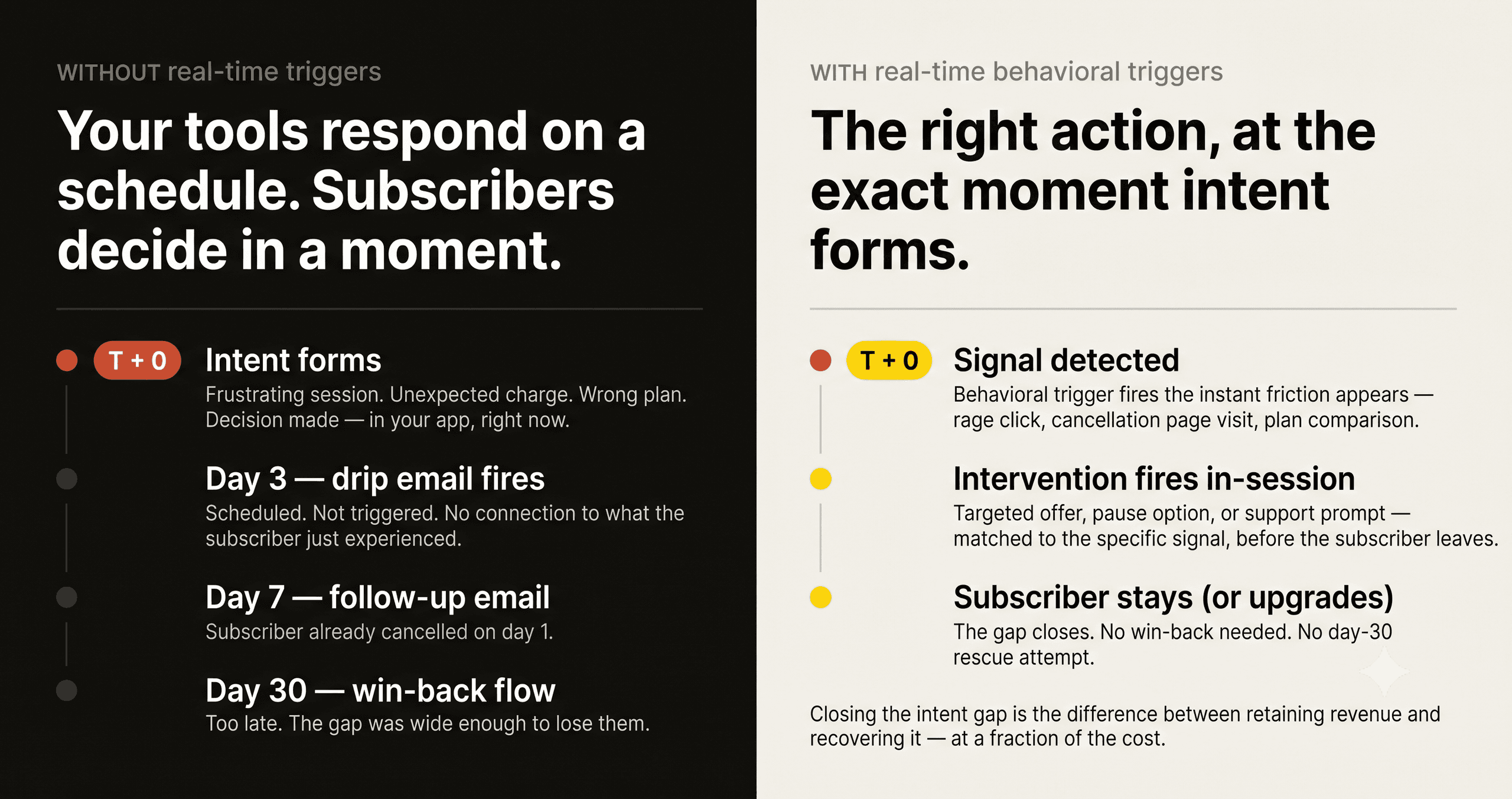
A subscriber decides in a moment: one frustrating session, one unexpected charge, one feature they can't access on their current plan. Their decision is made in real time, inside your app, based on what they're experiencing right now.
Most subscription tools respond on a different schedule entirely. Email campaigns fire on day 3, day 7, day 30. Win-back flows trigger after cancellation is confirmed. Upsell prompts appear on a rotation, not in response to a live signal. The timing is not mapped to those signals.
Missing these signals can result in:
Missed upsells
Missed limited time event engagement
Missed re-engagement opportunities
Missed deeper platform engagement
Lost subscribers
The three moments where subscriber intent is highest
Not all moments in the subscription lifecycle are equal. Three stand out for the combination of how clearly they signal intent and how consistently brands fail to act on them.
1. The first 30 days
Subscribers who churn early rarely announce it. They don't complain or submit cancellation surveys. They just stop showing up. By the time a welcome series finishes, the decision is often already made.
Early churn is disproportionately tied to activation gaps: the distance between a user signing up and actually experiencing your product's core value. For apps with complex onboarding, this gap is critical to overcome for long term subscriber activation.
Subscribers are far more likely to cancel quietly within the first 30 days if they fail to:
Link the right accounts
Configure their personal preferences
Reach that critical "aha" moment (pivotal moment where they see this as an ongoing service for their everyday) within the first week
The problem is that most lifecycle tools treat the first 30 days as a campaign sequence, not a behavioral monitoring window. Emails go out on schedule regardless of what the subscriber is actually doing. Nobody is watching for the signal that says: this person tried to set up their account twice, hit a wall, and hasn't come back.
2. The cancellation click
The moment a subscriber navigates to a cancellation page or clicks a cancel button is arguably the highest-intent moment in the entire subscription lifecycle. They haven't left yet. They're still in the app.
The cancellation click is a real-time signal that demands a real-time, in-app response. The right offer, surfaced at the exact right moment, can intercept the decision before it finalizes.
Consider offering:
A pause offer for a subscriber citing cost concerns
A plan downgrade for an annual subscriber who feels locked in
A feature demonstration for someone who hasn't discovered the core value
For brands relying on post-cancel win-back emails, this is already too late. The decision has been made, the confirmation has been sent, and the best a win-back flow can do is hope the subscriber changes their mind days later. This also invites friction with the resubscribing experience.
One publisher that reconfigured its cancellation intervention strategy — shifting from a post-cancel email to an in-app save flow at the point of click — saw recovery rates climb from 35% to nearly 49% according to Recurly data. The subscribers didn't change. The timing did.
3. The paywall and upgrade moment
When an active subscriber hits a feature limit or a paywall, they aren't just browsing. They are signaling clear purchase intent. They want something specific, and they are currently blocked from getting it. Most apps rely on static paywalls that present the exact same upgrade prompt to every single subscriber, regardless of their plan, history, or behavior.
These moments are not identical:
A long-tenured subscriber on a base plan hitting a paywall for the third time this month requires a specific approach.
A trial user hitting that same paywall on day one requires an entirely different approach.
Generic upgrade flows miss both of these nuances. The monetization gap doesn't come from a lack of persuasive upsell copy. It comes from a lack of behavioral context at the exact moment the upgrade signal fires.
Why existing tools can't close the intent gap
Closing the intent gap isn't a matter of using your current tools more aggressively. It's a structural problem with how most subscription tech stacks are assembled. It’s matching intent like cancellation desires with the right cancel save at the right time. More importantly, this is about making proactive subscriber lifecycle plays and anticipating before actions happen.
Email marketing platforms
Engineered for broad audience outreach on a set schedule, email marketing platforms function based on segment status and time-based delays rather than immediate behavioral cues. A campaign triggered on a specific day lacks insight into whether a subscriber is actively engaged, facing difficulties, or has departed. These systems typically lack vital billing data such as:
Renewal dates
Payment history
Plan tiers
This severely limits targeting accuracy even if the timing seems appropriate.
CRM and customer success tools
CRM tools were designed for human-led, account-level intervention. They're the right tool for a CSM managing a $50K enterprise account. They are not the right tool for intercepting a $15-per-month subscriber's cancellation click at 11pm on a Sunday. Scale and latency both work against them in the consumer and SMB subscription context.
Generic in-app messaging tools
Inapp messaging tools can deliver prompts inside the app, but most lack the subscription billing context that makes those prompts relevant. Knowing a subscriber clicked cancel is useful. Knowing they're on an annual plan with six months remaining, that their last payment failed and recovered, and that they've opened the upgrade page three times this month — that's what actually determines the right message. Generic messages get generic results.
What billing-aware behavioral triggers look like in practice
The right system monitors subscriber state continuously and fires responses the moment a relevant signal appears. It also contains access to the full billing and subscription context needed to make that response useful.
In practice, this means the trigger doesn't just know that a subscriber is on a cancellation page. It knows they're on an annual plan, that they're six months in, that their last two sessions lasted under two minutes, and that their stated reason in a previous touchpoint was "too expensive." That context shapes the offer: not a generic "don't go" message, but a pause option that costs them nothing and keeps the relationship alive.
Three things separate billing-aware triggers from the campaign-based alternatives:
Subscriber state, not just behavior: The trigger is informed by plan type, billing cycle, payment history, trial day, renewal date.
In-app, in-moment delivery: The response fires inside the product at the moment of intent, not in the next send window.
Contextual offers logic: The intervention is shaped by what's true about this specific subscriber right now — not just what's true about the segment they happen to belong to.
How to audit your own intent gap
Most subscription teams discover their intent gap by accident. A few structured questions surface it faster.
1. What happens in your product when a subscriber clicks cancel?
If the answer is "they get a confirmation email" or "our win-back sequence starts," you have a post-decision response, not an intent intercept. The gap is at the click, not after it.
2. What subscriber context does your in-app messaging have access to?
If your messaging tool can't see plan type, billing cycle, or payment history, it's operating without the information needed to deliver the right message. Prompts that feel generic usually are.
3. When does your first response fire for a new subscriber who goes quiet?
If it's a scheduled email at day 7 or day 14 regardless of behavior, you're not monitoring for the activation gap. A subscriber who tried twice and stopped engaging on day 3 needs a different response than one who is actively using the product.
4. Where does your voluntary churn actually originate?
Each moment presents it’s own opportunity whether thats:
Cancellation click
Early-lifecycle drop-off
Paywall abandonment
You can target each gap specifically.
If your subscription stack is built around email cadences and post-cancel win-backs, you're operating after the moment has passed. Recurly Engage intercepts subscriber intent while it's still actionable — with in-app triggers, billing context, and real-time response logic built for the moments that actually move the number.
Learn how Recurly Engage works
Frequently asked questions
What is the intent gap in subscription management?
The intent gap is the window between when a subscriber signals a decision — cancel, downgrade, disengage — and when a subscription business can respond. Most tools operate on campaign schedules and can't act in real time, which means the window closes before any intervention fires.
What tools close the subscription intent gap?
Closing the intent gap requires a system that combines behavioral monitoring with billing context and can deliver in-app responses in real time. Tools that operate on email delays, scheduled campaigns, or static paywall logic can narrow the gap but can't close it. They lack the timing and context required to intercept subscriber decisions at the moment they form.
How do behavioral triggers reduce voluntary churn?
Behavioral triggers respond to specific subscriber actions — a cancellation click, repeated paywall encounters, early-lifecycle disengagement — in real time, inside the product. Because they fire at the moment of intent rather than after the fact, they reach subscribers while a decision is still in progress, which is when interventions are most likely to work.
What is billing-aware subscriber engagement?
Billing-aware engagement means that messages, offers, and interventions are informed by a subscriber's full billing and subscription state — plan type, payment history, renewal date, trial day — not just their click behavior. This context determines what the right response is: a pause offer, a plan downgrade, an upgrade prompt, or a feature demonstration. Without it, even well-timed prompts are generic.
What is automated cancellation prevention?
Automated cancellation prevention is the use of tools to trigger an automatic save flow when a subscriber tries to cancel. This usually involves a discount, a special deal, or a pause offer.



