April 10, 2026
What is subscription lifecycle management? The tools and strategies you need to drive LTV


TABLE OF CONTENTS
TOPICS
RELATED POSTS

Our guide will walk you through the entire process of managing the lifecycle, where to maximize revenue, and how subscribers are engaged in the process.
Highlights:
Subscription growth moderated 12.6% in 2025, down from 15.4%. This makes retention even more valuable for most businesses
Subscription lifecycle management is about overseeing and creating the specific engagement tools to manage a subscribers’ journey with your product.
Subscription lifecycle management covers 5 stages: acquisition, activation, engagement, expansion, and renewal.
Engagement methods should be included in each phase of the lifecycle, including timely messages, micro-subscriptions, frictionless checkout, cancel saves, personalized onboarding journeys, and more.
Subscription lifecycle management software should allow you to gain visibility into how your subscribers act on the platform, engage with different products, and drive long term retention.
Fraud prevention is one of the most underinvested lifecycle capabilities that has real world financial consequences.
What is subscription lifecycle management exactly?
Subscription lifecycle management (SLM) is the practice of managing the full relationship between a subscription business and its subscribers. This consists of creating a journey through each customer phase, including initial acquisition through activation, engagement while on the platform, expansion into new plans or products, and renewal or win-back if they churn.
It encompasses the processes, tools, and strategies used to maximize subscriber lifetime value at every stage of the journey.
SLM example: A subscription company uses loyalty points to drive long-term retention with the promise of free rewards or exclusive products.
Subscription lifecycle management can encompass recurring billing, retention methods, churn prevention, and more. SLM describes the whole process of engaging subscribers and is focused on managing that relationship and how it fits into that strategy.
SLM vs. billing: an important distinction
Billing infrastructure handles the entire transaction including the charge, dunning, and the receipt. Subscription lifecycle management handles the relationship such as the context, behavior, the intervention, and the experience. Billing infrastructure plays an important role in facilitating that lifecycle.
So why does this matter exactly?
Last year, 52% of consumers canceled at least one subscription due to not using the service enough. Payments, engagement, loyalty, and product planning play an important role in the lifecycle. A company can have world-class billing infrastructure and still lose subscribers at an alarming rate if it has no SLM strategy.
The 5 stages of the subscription lifecycle
Every subscriber relationship moves through a general lifecycle that is easy to follow.
1. Acquisition:
The lifecycle begins before the first charge. How a subscriber discovers, evaluates, and converts sets the tone for everything that follows. Recurly's data shows that traditional trial conversion has been trending down — from 47% in 2021 to 34% in 2025 — while micro-subscriptions (day passes, weekend access, short-term plans) are filling the gap, now converting 13% of buyers into recurring subscribers.
Plan design, pricing structure, and checkout experience are all lifecycle levers. The right pricing strategy and plan offer converts higher and retains subscribers for longer.
Traditional marketing focus: digital ads, content creation, influence marketing.
Traditional payments focus: conversion rate, CAC, trial-to-paid conversion, payment authorization rate at signup.
SLM focus: frictionless checkout, right plan presentation, micro-offer design, regional payment optimization.
A lot of companies can release one plan without understanding who the user is — who's actually paying for the account. In a lot of situations you have parents paying for the subscription, but the child is the actual user. It's about understanding your market, who's paying, and then offering subscription flexibility — multiple price points at different offerings that's going to be a fit for everybody. — Daniel Shipley, Customer Success, Recurly
2. Activation and onboarding
Subscribers who don't experience the product's core value quickly are far more likely to churn before they ever form a habit. Most subscriptions have an expansive acquisition playbook, but negate the onboarding user journey experience to maximize engagement from the very get-go.
Effective SLM treats activation as a distinct stage with its own triggers, interventions, and success metrics. That might mean in-app prompts that guide new subscribers toward high-value features, milestone messages that reinforce the decision to subscribe, or early engagement signals that identify at-risk accounts before they become churn statistics.
Traditional onboarding focus: time-to-value, feature adoption rate, Day 7 / Day 30 retention, early churn rate
SLM focus: in-app onboarding journeys, behavior-triggered nudges, proactive value reinforcement
What are some tactics you can employ to boost this onboarding process?
Customized flows based on user selection
In-app prompts to check out the latest products
Influencer collaborations and opening messages for new subscribers
Event promotion in app with reminder/banner notifications ready to go
Engagement triggers based on past 5, 10, 20, and 30 day activity
3. Engagement and retention
Because so many of subscription purchases are month to month, the transactions are top of mind for most consumers. If you are not producing value for them on a consistent basis, there is a good chance of a cancellation. Engagement predicts retention, and retention is the metric that matters most when acquisition growth is slowing. Recurly's 2026 data shows the average monthly customer churn rate across all industries sitting around 3–4%, with digital media and entertainment reaching 5.5%.
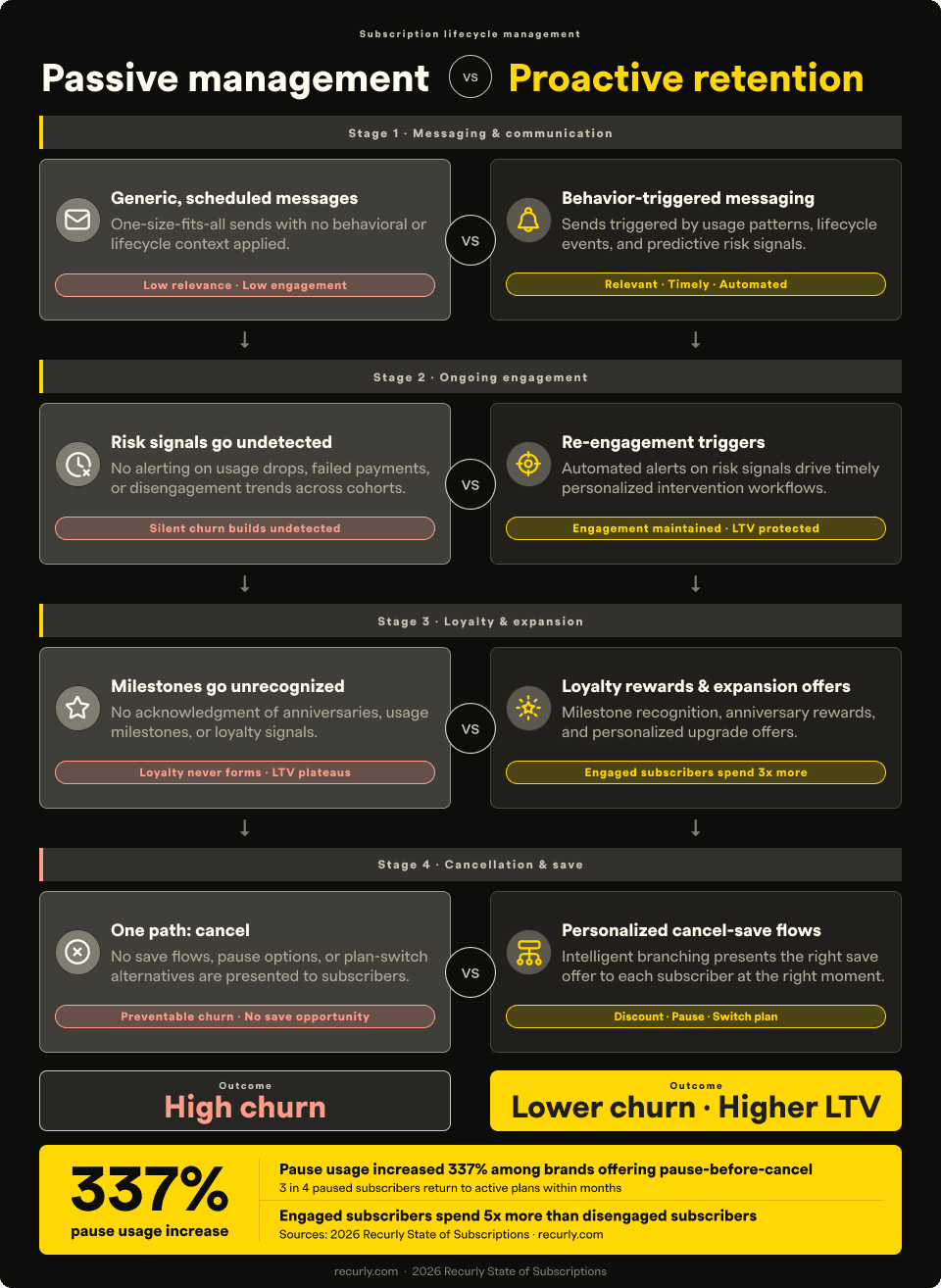
The most effective retention strategies at this stage are trigger-based, not calendar-based. A subscriber who hasn't logged in for 14 days needs a different conversation than one who just hit a usage milestone.
Flexibility is also proving its value as a retention tool: brands offering pause-before-cancel options saw pause usage increase by 337%, with three in four of those subscribers returning within months. Meanwhile, 38% of consumers say they'd prefer to pause rather than cancel outright.
Traditional retention focus: engagement score, churn rate, cancel-save rate, pause-to-return rate
SLM focus: personalized re-engagement, cancel-save flows, pause options, behavioral segmentation
4. Expansion and loyalty
If you’ve built a subscription lifecycle management system to foster engagement and long term retention, then this stage will come much easier. The highest-ROI moment in the subscriber relationship isn't the cancel screen. It's the window when a subscriber is active, engaged, and forming a genuine connection with the product. That's when an upgrade offer lands. That's when a loyalty reward creates real stickiness. That's when a referral ask converts.
The data backs this up. Engaged subscribers spend 3x more. The emerging model for this stage is what Recurly calls Loyalty-as-a-Service (LaaS) — systems that integrate behavioral data, advocacy tracking, and real-time offer delivery to transform engaged subscribers into active participants in the brand's growth. This is the operating territory of a product like Recurly Engage.
Expansion focus: upgrade rate, add-on attach rate, referral rate, subscriber LTV, NRR
SLM focus: in-product upsell delivery, loyalty rewards, exclusive offers, personalized experiences, advocacy programs
5: Renewal, win-back, and reactivation
Arguably just as important as the initial activation, renewal brings with it all the same value calculations the user has. Now, they have the experience to understand how your platform works.
Annual renewals are worth treating as a distinct high-risk moment. Annual plans generate 50–60% more revenue per user over time, but renewal rates have dropped to 82.9%, with only 23.3% of failed annual renewals recovered. Pre-renewal nudges, downgrade paths, and personalized renewal incentives are all proven interventions, but they require SLM infrastructure to execute at scale.
What should you do if the subscriber wants to leave?
Contrary to past belief, the lifecycle doesn’t end at cancellation. About 1 in 4 new subscriptions now come from a previously cancelled subscriber. Former subscribers are one of the most cost-effective and highest-converting audiences available to subscription businesses.
If your customers canceled in the past, there was a reason for it, and you better know that reason. Otherwise, you're going to miss out on the chance to bring them back. — Brian Gregory, Chegg in the 2026 State of Subscriptions
Voluntary churn: Focus on offers that will provide value to the churned customer. These can include plan changes, price reductions, free trials, micro- subscriptions, exclusive access, and more.
Involuntary churn: Implementing a revenue recovery strategy including dunning, intelligent retries, and more that can save subscribers before they fully churn. These subscribers didn’t choose to leave.
Renewal focus: renewal rate, win-back rate, failed payment recovery rate, cancellation reason data
SLM focus: pre-renewal engagement, payment recovery, win-back campaigns, smart dunning logic
What to look for in subscription lifecycle management software?
Not all subscription platforms manage the full lifecycle. Many handle billing and payment recovery well but leave the relationship management. The actual relationship and engagement tactics turn into a patchwork of disconnected tools. Enterprise businesses need software that does the job.
1. Subscriber data and behavioral segmentation
Effective SLM starts with understanding each subscriber's position in the lifecycle. Look for platforms that provide real-time behavioral segmentation by lifecycle stage, and deep integration with CRM, CDP, and analytics tools. If you can't see the subscriber clearly, you can't act on what you're seeing.
2. In-product experience delivery
The most effective lifecycle interventions happen inside the product, not in a follow-up email. A modern SLM platform should enable your team to build and deploy in-app prompts, upsell offers, and save flows without engineering dependencies. The important caveat: every intervention needs to earn its place in the subscriber experience. Anything that adds friction to the checkout or renewal flow risks abandonment. The standard for in-product messaging should be relevance and timing, not volume.
Features to look for: A/B testing, low-code or no-code capabilities, pre-built prompts that are ready to use day one.
When you're engaging your customers on the platform it needs to be in a meaningful way — how are they using your platform, are you engaging them in the right way at the right time. That's super important. You don’t want to flood them with things they don’t care about.— Daniel Shipley, Customer Success, Recurly
3. Cancel-save and churn intervention
Cancel-save flows are table stakes, but not all implementations are equal. Look for dynamic flows that branch based on the subscriber's stated cancellation reason. A subscriber leaving because of price needs a different offer than one leaving because they've lost interest. Personalized cancel-save journeys, tailored to the subscriber's reason for leaving, have proven to convert potential churn into renewed revenue.
Check out our ultimate guide + examples on cancellation flows here.
4. Expansion and loyalty mechanics
Your expansion efforts need to be timely, personalized, and help build loyalty that sticks for your brand.
Features to look for: configurable loyalty rewards, entitlement management, referral program support, and one-click subscription upgrade flows.
5. Intelligent payment recovery
Involuntary churn is subscribers who are lost to failed payments and not active cancellation. Smart dunning logic, payment retry sequencing, account updater services, and alternative payment method optimization can recover a significant portion of this revenue automatically. Implementing the right system keeps your subscribers on the platform without having to trigger an entire win-back campaign.
6. Fraud prevention
Fraud capabilities are among the most underinvested areas in subscription lifecycle management — not because merchants don't care, but because investment typically happens reactively, after a fraud event has already damaged revenue and eroded trust. By then, the cost of remediation far exceeds what proactive tooling would have required.
For SLM specifically, fraud sits at the intersection of acquisition and payment recovery. Failed payments flagged as fraud skew churn diagnostics and inflate involuntary churn numbers, making it harder to understand the true state of subscriber health.
A major area of underinvestment for companies is often fraud capabilities. Not many invest until they have a fraud problem, and by then it's too late. Fraud tools are not inexpensive, but they're there to reduce risk in the organization. — Daniel Shipley, Customer Success, Recurly
5 subscription lifecycle management best practices
1. Map your lifecycle before you automate it
Before building engagement workflows, document the actual stages your subscribers move through. Identify:
Engagement metrics within a 1-week, 1-month, 1 quarter, and 1 year.
Churn concentration areas such as after initial trial, renewal, 6 months mark, etc.
Opportunities where customers upgrade, such as live events, timed exclusive, and deep discounts.
Instrument each stage with data collection before adding automation. You cannot grow what you cannot measure.
2. Build trigger-based interventions, not campaign calendars
A subscriber who logs in for the first time in 30 days needs a re-engagement nudge. A subscriber who just completed a key action is primed for an upsell. A subscriber who hits their usage limit is a natural upgrade candidate. None of these moments align neatly with a monthly email schedule. Design your intervention logic around subscriber behavior to maximize ROI.
3. Invest in the expansion moment before churn becomes the problem
The highest-ROI investment in the subscriber lifecycle is converting engaged, satisfied subscribers into brand advocates and revenue multipliers. Loyalty rewards, exclusive access, and personalized milestone recognition during the expansion stage reduce upstream churn by building real attachment.
4. Treat involuntary churn as a recoverable revenue line
Failed payments account for a meaningful share of total subscription churn, and this loss is largely preventable. Smart dunning design (with different cadences for monthly versus annual plans), payment retry sequencing, and proactive card-on-file refresh ahead of peak renewal periods can recover revenue that would otherwise disappear silently. Build these capabilities into your SLM infrastructure before you need them.
5. Don't leave payment recovery on the table
Failed payments account for a meaningful share of total subscription churn — and unlike voluntary cancellation, this loss is largely preventable. Two quick wins that Recurly's customer success team consistently finds underdeployed: account updater (which automatically refreshes expired or replaced card details before a payment fails) and an appropriately long dunning window that gives retry logic time to work. Both are low-effort, high-return additions to any SLM program.
Frequently asked questions about subscription lifecycle management
What is the difference between subscription lifecycle management and customer lifecycle management?
Customer lifecycle management (CLM) is the broader practice of managing customer relationships across any business model. Subscription lifecycle management is CLM applied specifically to recurring revenue businesses. The key difference is the subscription model, the relationship never fully ends, which means every moment between sign-up and cancellation is either building or eroding the case for renewal. SLM also introduces dynamics that don't exist in generic CLM: recurring billing as a relationship signal, the expansion stage as a distinct revenue lever, and win-back as a formal lifecycle stage rather than an afterthought.
What is the difference between subscription lifecycle management and customer journey mapping?
Customer journey mapping is a visualization tool — it helps teams document the stages, touchpoints, and emotional states a subscriber moves through. Subscription lifecycle management is the operational system that acts on what that map reveals. The map is the strategy; SLM is the execution.
What are the stages of the subscription lifecycle?
The five core stages are acquisition, activation and onboarding, engagement and retention, expansion, and renewal or win-back. Some SLMs may make another distinction around a “loyalty” phase for super users, but this depends on the type of subscription.
What metrics matter most in subscription lifecycle management?
The most important single metric is net revenue retention (NRR), which captures both churn losses and expansion gains from your existing subscriber base. Supporting metrics include monthly churn rate, cancel-save rate, payment recovery rate, upgrade rate, and subscriber lifetime value (LTV) by cohort.
What causes most subscription cancellations?
According to Recurly's 2026 State of Subscriptions, the top reasons subscribers cancel are not using the service enough (51%), price being too high (45%), and losing interest (32%). The first two are directly addressable through SLM — proactive engagement reduces non-usage churn, and flexible plan options like pausing address price sensitivity without losing the subscriber entirely.
How Recurly supports the full subscription lifecycle
Recurly was built on the premise that the subscription relationship is more than a billing event. Every product decision we make is grounded in the belief that every subscriber interaction is an opportunity to reinforce value, reduce friction, or deepen loyalty.
Here's how that plays out across the lifecycle:
Acquisition and plan design: Flexible pricing models (fixed, usage-based, tiered, ramp, prepay), A/B testing for offer optimization, free trial management, and micro-subscription support. These capabilities are configurable without engineering dependencies.
Engagement and retention: Recurly Engage delivers in-product experiences that drive upgrades, surface discounts, retain at-risk subscribers, and reactivate dormant accounts in real time. No-code journey builder. Single-click subscription management for subscribers.
Cancel-save flows: Personalized cancellation journeys that branch based on subscriber-stated reasons, with a full offer library including discounts, pauses, plan downgrades, and loyalty rewards.
Loyalty and expansion: Configurable loyalty reward in-app prompts, entitlement management, and real-time upsell delivery at trigger-based lifecycle moments. The expansion moment, operationalized.
Payment recovery: Smart dunning with cadences tuned by plan type, account updater services, and payment retry sequencing that recovered over $1.6 billion in revenue in 2025.
Analytics: Cohort churn analysis, LTV by segment, renewal forecasting, and subscriber health scoring across the full lifecycle.



