
July 6, 2026
Is Recurly Engage right for your subscription business? Here's how to tell.


TABLE OF CONTENTS
RELATED POSTS

The most robust app-engagement platforms are built for subscriptions and built around billing logic to reinforce monetization.
The difference comes down to three things:
Real-time data: Every targeting decision reads the exact, live subscription state.
Direct execution: Every action triggers directly against a billing record.
Growth autonomy: Your growth team can launch and iterate instantly without developer tickets generated.
Picking the wrong in-app engagement platform is an expensive mistake. The engineering hours spent on implementation, the lifecycle programs designed to its constraints, the experiments that all hinge on the right capabilities and integration.
What to look for in a subscription engagement platform?
Before comparing platforms, it helps to be precise about what's broken. In-app engagement tools get purchased for a wide range of reasons, and the right solution depends heavily on which problem is actually the priority.
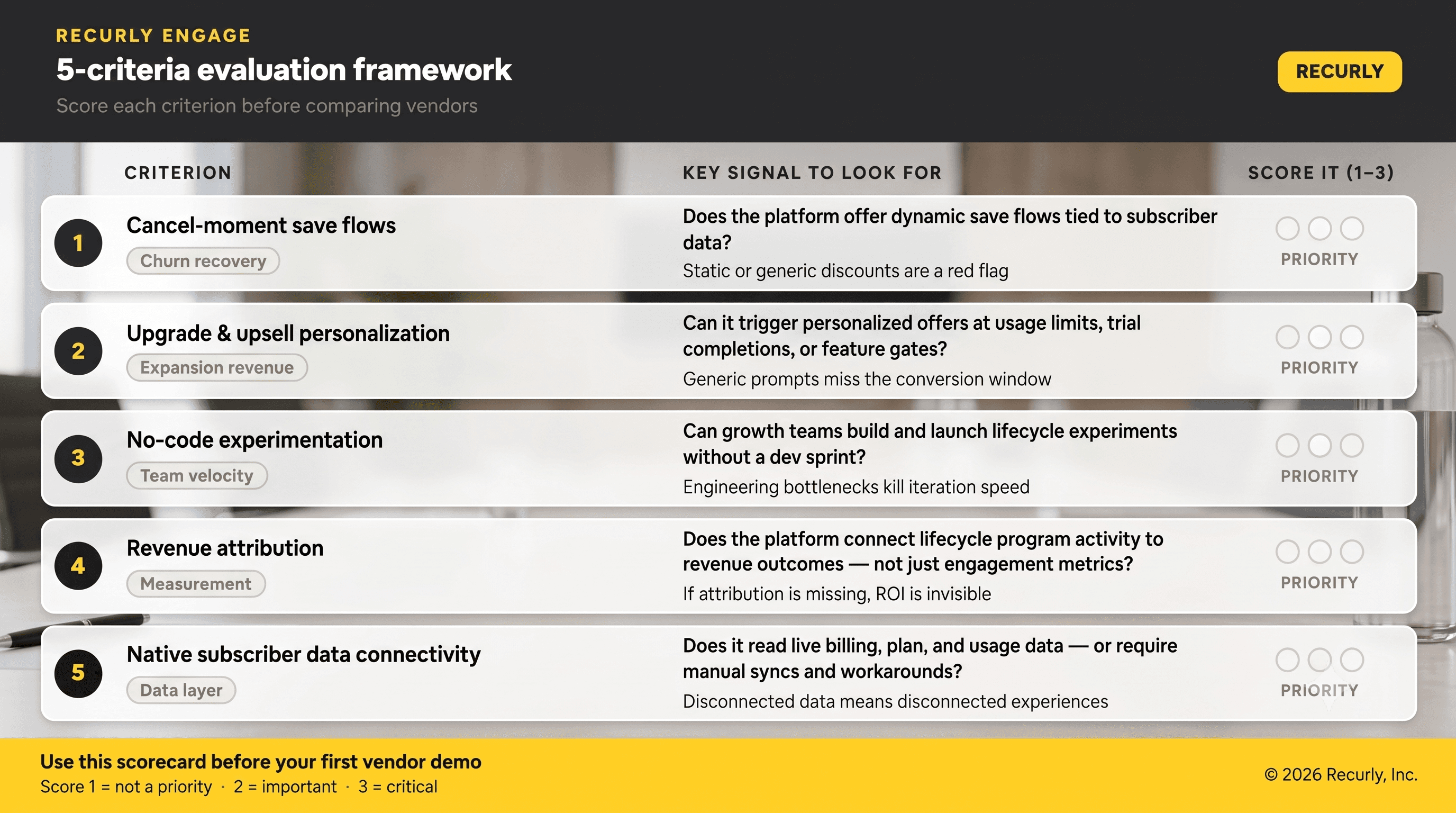
The most common problems growth teams at subscription businesses are trying to solve fall into a few categories:
Churn at the cancel moment. Subscribers are navigating to the cancel screen and leaving. The business either has no save flow, has one that's static and hasn't been updated in years, or has one that isn't connected to subscriber data so it offers the same generic discount to everyone.
Missed upgrade and upsell moments. Subscribers are hitting natural upgrade moments inside the product — hitting a usage limit, completing a trial, reaching a feature gate — and the experience either isn't there or isn't personalized enough to convert.
Engineering as a bottleneck. Growth and product teams have a backlog of lifecycle experiments they want to run, but every one requires a development sprint. The result is that the team with the most context on subscriber behavior has the least ability to act on it.
Disconnected attribution. Lifecycle programs are running, but it's impossible to tie them to revenue outcomes. Engagement metrics exist; revenue impact doesn't.
The five questions that actually separate these platforms
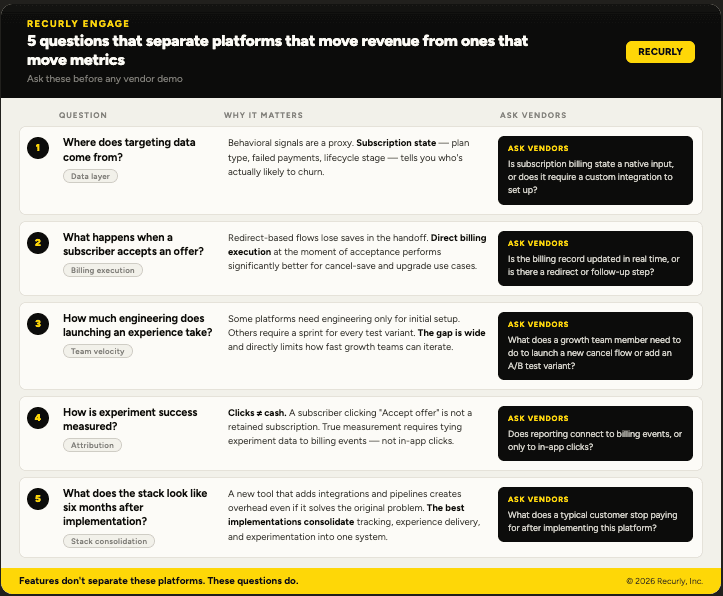
Features matter, but they're not what separates a tool that moves revenue from one that moves engagement metrics.
These five questions tend to surface the meaningful differences.
1. Where does the targeting data come from?
Some platforms target based on behavioral signals: sessions, clicks, feature usage, time in app. Others target based on subscription data: plan type, payment history, lifecycle stage, trial status, days until renewal.
For subscription monetization specifically, behavioral signals are a proxy. Knowing that a subscriber hasn't opened the app in 11 days tells you how interested or involved they are with your product.
Knowing that they're on a month-to-month plan, had a failed payment two weeks ago, and have never used the feature tied to their plan tier tells you they are more likely to churn than not.
Ask vendors: What data sources does targeting pull from, and how current is that data? Is subscription billing state a native input, or does it require a custom integration to set up?
2. What happens when a subscriber accepts an offer?
When a subscriber accepts a save offer, a discount, a pause, or a plan change inside your product, two things need to happen: the subscriber sees a confirmation, and the billing record gets updated. Does the platform execute that billing change directly, or hands the subscriber off to a separate flow to complete the action?
Redirect-based flows — where accepting an offer sends the subscriber to a checkout page, a support form, or a separate confirmation step — risk save potential in that handoff. Platforms that automate billing changes directly at the moment of acceptance perform significantly better at cancel-save and upgrade use cases.
Ask vendors: When a subscriber accepts an offer, what exactly happens next? Is the billing record updated in real time, or is there a redirect or a follow-up step?
3. How much engineering does it take to launch and change experiences?
The gap between platforms here is wide. Some require engineering involvement for initial implementation only, with a visual builder that lets non-technical teams build and iterate from that point forward. Others require engineering for every new experience, every A/B test variant, and every copy change. Some offer self-serve capabilities that work for simple use cases but require developer support for anything complex.
Ask vendors: After initial implementation, what does a typical growth or product team member need to do to launch a new cancel flow? To add an A/B test variant? To change the offer in an existing experience?
4. How is experiment success measured?
When a user is trying to quit, you only care about one thing: Did they actually stay subscribed, and did they do it at a higher rate than the control group?
The catch is that you can't just track in-app behavior to find out.
Clicks =\ cash: A user clicking "Accept Offer" is not the same thing as a retained subscription.
The reality gap: Cards still fail, users change their minds, and systems glitch.
The fix: True measurement requires tying your experiment data directly to your billing engine, ensuring the entire attribution chain is bulletproof.
Ask vendors: How does the platform attribute saves, upgrades, and conversions? Does reporting connect to billing events or only to in-app clicks?
5. What does the stack look like six months after implementation?
A new tool that requires building new integrations, maintaining new data pipelines, and onboarding new vendor relationships adds overhead even if it solves the original problem.
For most mid-market subscription businesses, that means consolidating behavior tracking, in-product experience delivery, and experimentation into a single system rather than stitching together separate tools. It also means being honest about what you're already paying for and whether it's actually being used.
Ask vendors: What does a typical customer stop paying for after implementing this platform? What does their stack look like before and after?

Where common tool categories fall short for subscriptions?
Omni-channel lifecycle platforms
Tools built for cross-channel engagement (email, push, SMS, in-app) are often already in place for broad lifecycle marketing, and they do that job well. These platforms are designed to send messages, not to write billing changes.
They can trigger a win-back email after a cancellation; they can't intervene before it. For teams that need in-product experiences tied directly to billing actions, a separate execution layer is required regardless of how mature the lifecycle platform is.
Product analytics and in-app guidance tools
Product teams often have a tool in place for onboarding flows, feature adoption tracking, and UX research. The limitation for subscription monetization is that in-app experiences built in these tools aren't connected to billing state or matching intent. They can surface a message to a subscriber identified as at risk based on usage signals, but they can't execute a save, a plan change, or a payment recovery at that moment.
Point solutions for cancel-save
Dedicated cancellation flow tools solve a specific problem well and often have a straightforward ROI story. The limitation is scope: they address voluntary churn at the cancel moment but don't extend to the rest of the subscriber lifecycle. Trial conversion, upsell prompts, win-back flows, and involuntary churn recovery all require additional tooling.
Homegrown cancel flows
Most subscription businesses build their own cancel flow at some point, usually because it felt simpler than a vendor integration at the time.
The problem isn't the initial build. It's that homegrown flows are expensive to change. Every copy update, every new offer, every A/B test requires engineering. The result is a flow that was optimized once and hasn't meaningfully evolved since, while subscriber behavior has continued to shift.
Where Recurly Engage fits
Recurly Engage is built specifically for subscription monetization: in-product experiences triggered by subscription and billing data, with one-click execution of billing actions and a no-code builder for growth and product teams. It's the platform for subscription businesses trying to close the loop between subscriber intent and revenue outcome without requiring engineering for every iteration.
It fits best when a business has all of the following:
A logged-in product experience where high-intent moments (cancel attempts, trial expirations, upgrade prompts) happen inside the app.
A defined subscription lifecycle with clear states: trial, active, at-risk, lapsed.
A growth or product team with a backlog of lifecycle experiments that keep getting queued behind engineering priorities.
Sufficient subscriber volume to run meaningful experiments (typically 10,000+ paying subscribers and 50,000+ monthly active users).
Annual subscription revenue of $25M or more, where the compounding value of improved save rates, conversion rates, and ARPU justifies the investment.
It fits across a range of verticals: streaming and OTT, digital publishing, fitness and wellness apps, e-learning platforms, and high-engagement SaaS. If you want to learn more about Recurly Engage, you can get started here.
Where Recurly Engage is not the right fit
No logged-in product experience. If your subscription is primarily a service delivered offline or through a non-digital channel, there's no in-product surface for the platform to operate on.
Early stage (under roughly $10M ARR). The investment compounds at scale. At an early stage, subscriber volume may not support statistically significant experimentation, and a simpler solution may be more appropriate while product-market fit is still being established.
Transactional or one-time purchase models. Engage is built for recurring subscription relationships. Without an ongoing subscriber lifecycle to optimize, the core capabilities don't apply.
Highly constrained tech stacks. Implementation requires an SDK or tag manager and the ability to pass user-level subscription data to the platform. If the data infrastructure to support segmentation doesn't exist, implementation will be difficult regardless of platform fit.
Teams where retention isn't yet a strategic priority. If leadership is focused entirely on acquisition and churn is not on the roadmap as a problem to solve, Engage will feel misaligned with current priorities.
Frequently asked questions
What are the best in-app subscription engagement tools?
The most effective tools for subscription businesses are those built with subscription billing logic as a first-class input, not as an integration layer added on top of a general-purpose messaging platform. Key capabilities to evaluate: does targeting read actual billing state, can the platform execute billing actions directly, can non-technical teams build and iterate without engineering support, and does experimentation tie to billing outcomes rather than engagement proxies.
What should I look for in a subscription engagement platform?
The five questions that tend to surface the most meaningful differences:
Where does targeting data come from (behavioral signals vs. actual billing state)?
What happens when a subscriber accepts an offer (redirect vs. direct billing execution)?
How much engineering does ongoing use require?
How is experiment success measured (engagement proxies vs. billing outcomes)?
What does the stack look like after implementation?
What is in-app paywall management software?
In-app paywall management software enables subscription businesses to build, deploy, and optimize paywalls inside their product without requiring engineering for each iteration. More capable platforms in this category let teams personalize paywall content based on a subscriber's actual plan state, lifecycle stage, and payment history rather than serving the same experience to all users.
What are Redfast alternatives?
Recurly acquired Redfast, and its technology now powers Recurly Engage. If you were evaluating Redfast as a standalone product, Recurly Engage is the current platform with expanded capabilities and ongoing investment.
Is Recurly Engage a good fit for SaaS businesses?
High-engagement SaaS is a supported vertical for Engage, particularly for businesses with meaningful free-to-paid conversion journeys, plan upgrade paths, and usage-based trigger points that occur inside the product. The fit is strongest when there's a defined subscription lifecycle and sufficient subscriber volume to support experimentation.



