
April 30, 2026
The case for smarter failed payment recovery: What the data actually shows


Key highlights:
- Single-merchant retry logic plateaus because it can only act on its own data. Recovery decisions informed by network-wide payment patterns consistently outperform those made in isolation.
- In analysis of enterprise transaction data, optimized retry strategies improved failed payment recovery rates from approximately 53% to 71% — without replacing a single component of existing billing infrastructure.
- 90% of recovered transactions occur within the first 10 days of a failed payment, meaning the quality of decisions made early in the retry window determines the majority of recovery outcomes.
Most leadership can tell you the harms of voluntary churn, which is subscribers who leave by their own choice through a cancelled membership. There are roadmaps built around it, retention programs funded because of it, and entire product teams dedicated to reducing it.
A hidden million dollar revenue loss, however, is involuntary churn. Involuntary churn is the revenue lost not because a subscriber chose to leave, but because a payment failed. It accounts for an estimated 20% - 40% of total churn across subscription businesses.
That means for every subscriber who clicks "cancel," there's another one who disappears quietly, without ever making that choice. Their card expired. Their bank flagged the transaction. A temporary hold blocked the charge. The subscription ends because no action is taken.
This is subscription revenue leakage at scale. And for enterprise subscription businesses processing millions of transactions per month, even marginal improvement in failed payment recovery rates translates directly to material top-line impact.
What is payment recovery and why doesn’t it always work?
On a basic level, payment recovery is the process of retrying payments after they fail. A payment retry initiates within a couple of hours of the original transaction, or a secondary payment method is tried on the second attempt. Basic retry coverage captures a meaningful percentage of recoverable transactions. But it plateaus quickly, and for a predictable reason: the decisions driving those retries are only as good as the data behind them.
A merchant's ability to see payment retries is limited to their customer base and payment behavior. It lacks the broad perspective to see an issuer's current behavior across thousands of other merchants, know that a difficult-looking failure code succeeds 18% of the time when retried on a Tuesday, or recognize that changing payment methods for a card type significantly boosts authorization likelihood in the first retry window. The right payment orchestration and recovery separate you are what separate you from a recovery rate of 51% to 70%.
Static retry logic, built on a single merchant's data, does not have access to those capabilities. Homegrown billing infrastructure limits your growth capabilities.
Optimized retry strategies informed by network-level payment data improve failed payment recovery rates by 10%- 20% points over single-merchant retry logic alone.
Source: Recurly network data, 2026
What good recovery performance looks like
Defining success in failed payment recovery requires the right benchmarks. Here is what the data suggests enterprise subscription businesses should be targeting:
- Recovery rate: A well-optimized recovery program should achieve a 10%- 20% point improvement over baseline retry performance. If your current recovery rate is in the low-to-mid 50s, a rate in the high 60s to low 70s is an achievable target with the right strategy.
- Time to recovery: 90% of successful recoveries happen within the first 10 days. Programs that front-load recovery intelligence, applying optimized decisions early in the retry window rather than defaulting to a flat schedule, materially outperform those that do not.
- Cost per dollar recovered: In a success-based model, cost scales with results. A well-structured program should deliver a single-digit percentage cost against recovered revenue, with no upfront risk. That solution only makes money when you make money.
- Operational footprint: Integration should require minimal engineering lift. If building or deploying a recovery layer takes months and requires significant internal resources, the architecture delays growth.
Failed payments are not the end of a transaction
Every declined transaction carries information — about the issuer, the card type, the failure category, the time of day, the geography, and the subscriber's history. Individually, any one of those signals is limited. Aggregated across thousands of merchants, millions of transactions, and multiple payment methods, they become a recovery intelligence engine.
Failed subscription payments are expected to cost businesses $129 billion in lost revenue in 2025 due to involuntary churn.
SQmagazine
They are not focusing on one set schedule for retries. They target every failed transaction at every point in the recovery window, which is a combination of timing, payment method, and retry sequencing to ensure the highest probability of success. Maximizing recovery windows is critical for industries like digital media and entertainment, education, and travel which see higher involuntary churn rates on average.
What the data actually shows
In analysis of transaction data from an enterprise big-box retailer with membership subscriptions operating at significant scale, a clear performance gap emerged between their existing retry approach and what optimized recovery logic could achieve.
Their current system was recovering approximately 53% of eligible failed transactions, a figure that, without a benchmark to compare against, might appear reasonable. Against optimized retry strategies informed by network-level payment patterns, that figure increased to approximately 71% on the same transaction set.
That same enterprise membership retailer generated an estimated $1.9 million in incremental recovered revenue over those two months, equivalent to approximately $11.6 million annualized.
Source: Recurly network data, 2026
In another analysis by Recurly, transaction data from a global on-demand food delivery subscription platform processing tens of millions of transactions per month, optimized retry logic projected a recovery uplift of $3.6 million over two months, equivalent to $21.6 million in annualized recovered revenue versus existing performance.
Neither of these outcomes required replacing a billing system. Neither required rebuilding internal retry infrastructure. The billing platforms at both companies remained exactly as they were. What changed was the intelligence informing recovery decisions, and the window across which recovery attempts were sequenced.
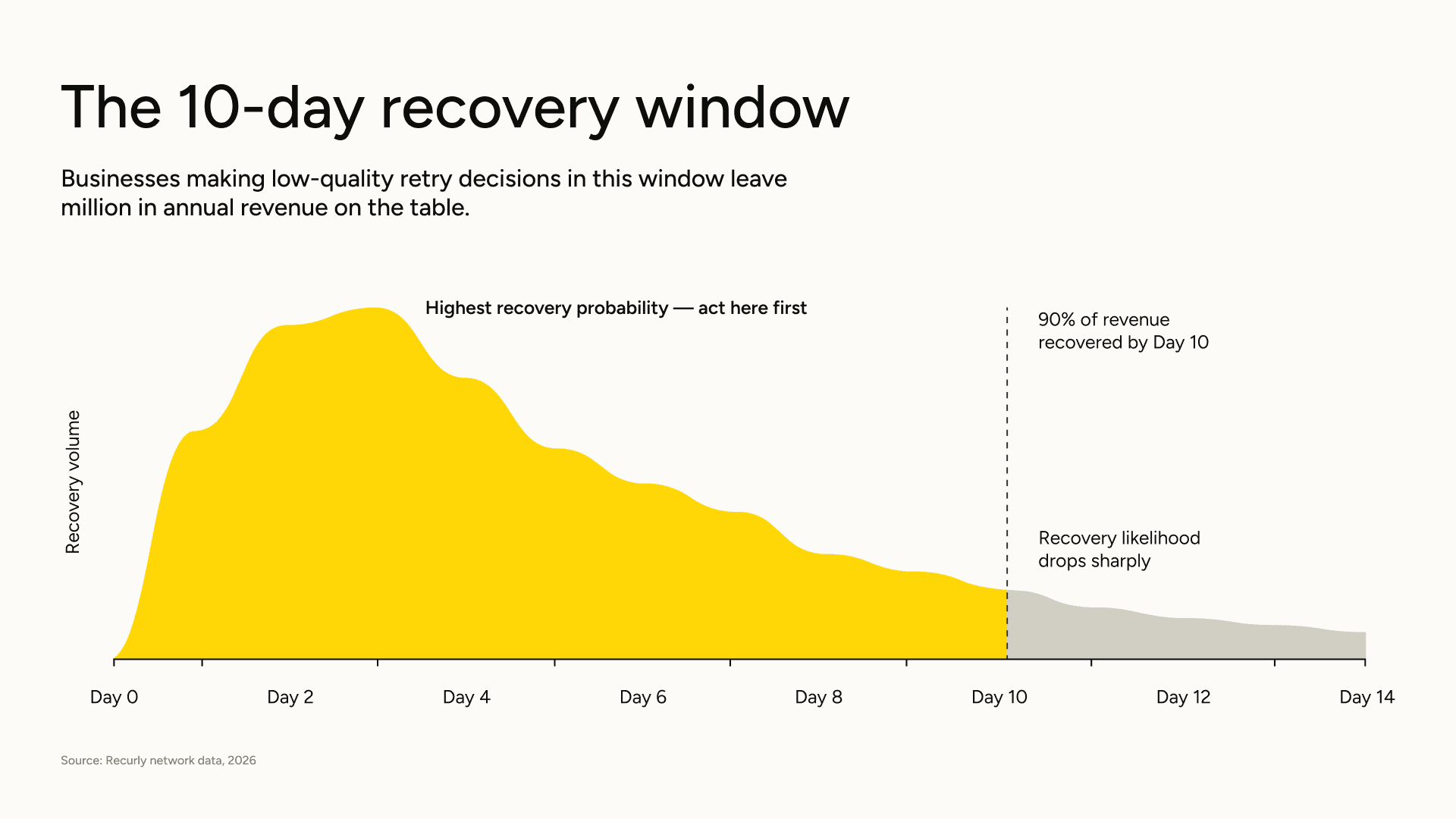
That window is narrow to get payment retries correct. Most businesses are making those decisions with limited data. The gap between their current recovery rate and what's achievable is, in most cases, measured in millions of annual revenue. This only compounds as payment orchestration and retry logic implements AI management into these workflows.
We tend to see plus 20% retention simply by doing the right payment orchestration and enabling the consumer to have a frictionless experience without them even knowing it. That's the power of recovery tools.
Sean Douglas, PayPal, 2026 State of Subscriptions
Can you recover more payment revenue without replacing your billing stack?
For businesses that have spent years building and optimizing homegrown subscription billing infrastructure, the idea of replacing it, or even significantly modifying it, is not a realistic option. Many roadblocks stand in the way:
- Engineering investment is too large
- Employees would have to retrain on a new system
- Operational risk to daily activities
- Loss of institutional knowledge within a platform
The good news is that better payment recovery does not require an entirely new billing infrastructure. An additive layer using API-based integration that receives failed transactions, applies optimized retry logic informed by network-level data, and returns results via webhook can help you solve this problem without replacing that infrastructure.
The positive of this approach is that:
- Initial billing software stays intact for use
- Customer experience remains fully under the merchant's control
- No duplicate charges, no force posts.
- No conflicting recovery attempts across systems
- Institutional knowledge of both products can start to build and be leveraged for optimal performance
The goal is to surround your billing infrastructure with better recovery intelligence, without disrupting the workflows, the teams, or the technical decisions that made it valuable in the first place.
Don’t leave money on the table
Closing the gap for payment recovery against the competition does not require rebuilding anything new. It requires access to a wider signal set and the intelligence to act on it at the right moment.
If you're losing revenue to failed payments at scale and want to understand what a data-informed recovery approach could mean for your business, you need the right tools.

TOPICS



