RECURLY RECOVER
Failed payments are not the end of a transaction
Up to 40% of churn isn't a choice. It's failed payments. Recover it with a standalone recovery layer that plugs into your existing billing stack — no rebuild required.
 Get in touch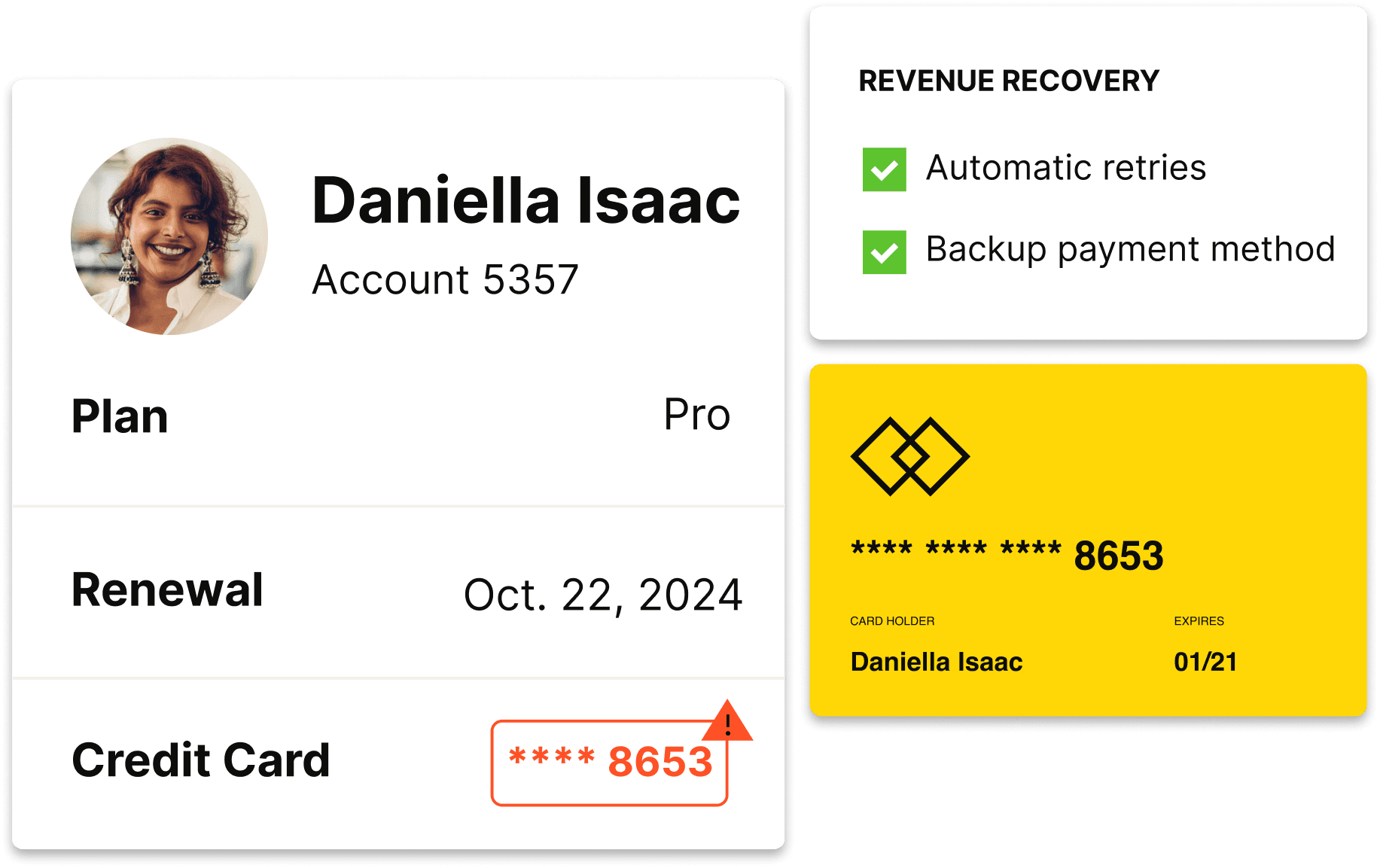
Capture 20% more revenue from day one
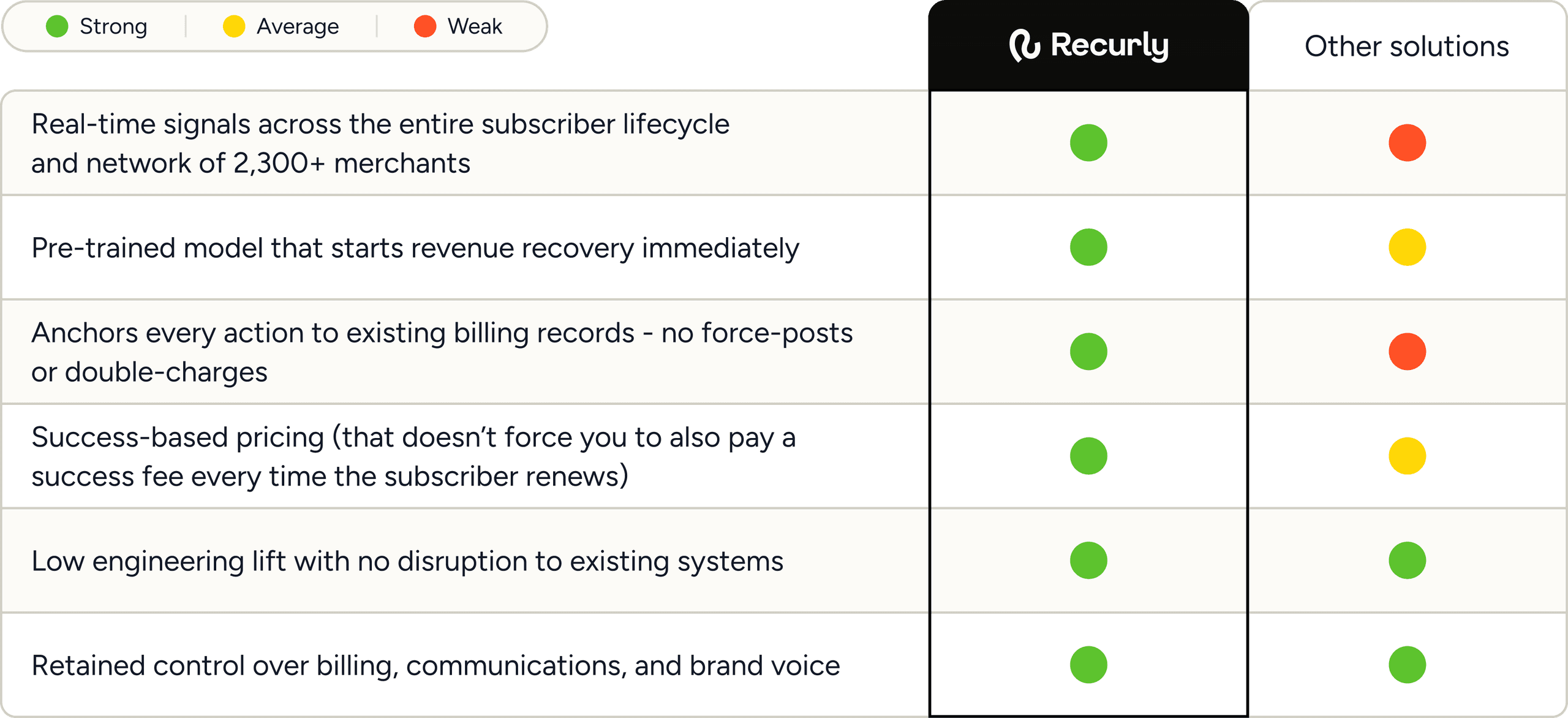
Single-merchant retry logic is a blind spot. We use intelligence from 2,300+ merchants to optimize every attempt, ensuring your recovery rates consistently beat the industry average.

Built into your billing system
Every retry is tied to your billing record — no force-posts, no double charges, no reconciliation headaches. You keep full control while we recover more revenue.

Network-driven decisions
Most tools only see your data. We learn from patterns across top merchants and 76M unique subscribers to apply what's working right now.

Instant impact on revenue
Skip the months of model training and ramp time. Our pre-trained engine applies optimized strategies instantly, proven to increase ROI from the start.

Support every payment method
Cards, ACH, wallets, and local methods. We don’t rely on a single path to recovery — because your subscribers don’t all pay the same way.
Why leading teams choose Recurly
Experience matters. Enjoy unmatched, proven scalability with Recurly.
2,300+
subscription businesses powered by Recurly
100M+
active platform subscribers
$10B
annual transaction volume
$1.7B
in annual recovered revenue
FAQs
No. Your billing system stays exactly as it is. Recurly integrates alongside it, specifically for failed transactions. We act as a complementary recovery engine, not a replacement.
It’s lightweight. Failed transactions are routed to Recurly’s recovery logic, where our machine-learning algorithms apply optimized retry strategies. Successful recoveries are returned back into your existing flow.
On average, subscription businesses see 10–20% more recoveries compared to their existing retry performance.
None. To start, we simply model 1–2 months of your anonymized transaction data to provide a complimentary recovery analysis. You’ll see the quantified uplift potential before making any decision.
The analysis itself can be completed in days. If you decide to move forward, routing failed transactions into Recurly is a low-lift implementation designed for speed and minimal disruption.
Dunning management and intelligent retries work in parallel to solve the same problem, but in different ways. Dunning focuses on customer communication — prompting subscribers to update their payment details. Intelligent retries operate entirely behind the scenes, optimizing retry timing and execution without any subscriber interaction. While they are technically independent, most merchants use them together to maximize recovery.
Most merchants treat generic declines as a single category, but they’re actually made up of many different underlying causes. We’ve been able to break those down — especially isolating things like insufficient funds — and model when a customer is likely to have funds available again. Because we see data across merchants and gateways, we can also resolve fragmentation in decline codes and better understand what’s actually happening at each point in the transaction chain. That allows us to make much more precise retry decisions and drive stronger recovery outcomes.
Our general recommendation is to push to three to four weeks of dunning.
Get started with Recurly
Join thousands of global brands that trust Recurly's 15+ years of expertise.